Introduction
One of the most significant police encounters during the Columbine attack reportedly happened outside the school, when School Resource Officer Deputy Neil Gardner exchanged gunfire with a suspect at the west entrance.
According to Gardner, he had just arrived in the senior parking lot when he saw an armed suspect wearing a dark blue flak jacket, a white t-shirt, and a backwards baseball cap standing just a couple of feet in front of the West entrance. As soon as he opened his car door, the suspect raised his rifle and fired in his direction, forcing Gardner to take cover behind a white Chevy Blazer. Gardner said he returned fire over the hood of the Blazer, firing four shots. Two minutes later the suspect fired at him again and Gardner shot four more rounds at the suspect.
Below is a map showing Gardner by the white blazer and the reported location of the rifleman. This photo was taken approximately an hour and forty-five minutes after the first alleged shootout.
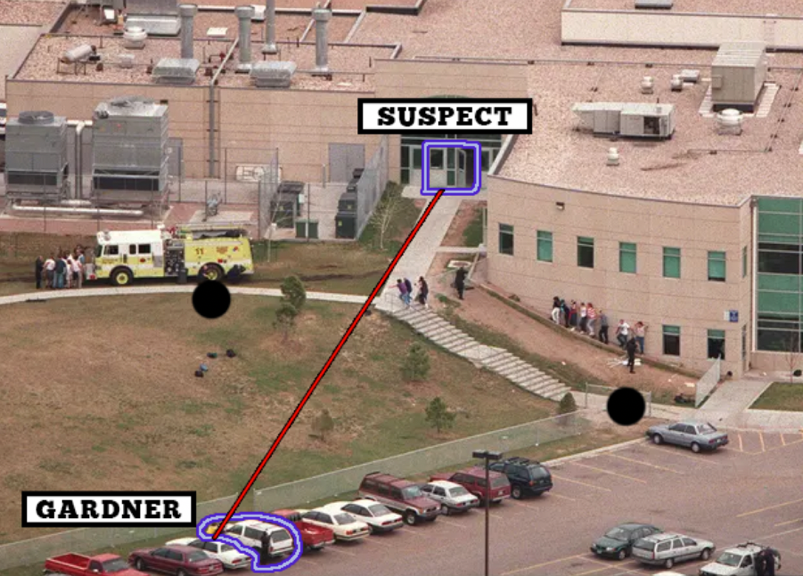
Officer Neil Gardner takes cover behind a white Chevy Blazer at approximately 1:12 p.m.
Source: Unknown.
Gardner’s reported shootout with the rifleman became a central part of the official Columbine narrative, and he was later awarded the Medal for Valor—the most honored award given by the Sheriff’s Office—for his actions that day. But there are a handful of problems with Gardner’s story that don’t match the evidence and cast doubt on where he was and what he was really doing during the first part of the attack.
Gardner Case Anomaly #1:
The Bullets Allegedly Fired at Gardner Into the Blazer
By the Rifleman Were Not Collected or Processed
Gardner said that the rifleman fired multiple rounds that struck the Blazer’s windshield, which should have made the Blazer a critical piece of physical evidence in the investigation. The damage to the Blazer was documented by investigators as “2 bullet holes in window, 1 grazing across hood—paint chipped.”
Since the Blazer took direct fire during the shootout, common sense would dictate that it should have been treated as part of the crime scene and seized, searched, photographed, and processed for ballistic evidence.
Curiously, the Blazer was completely ignored by investigators.
The information wasn’t just omitted from the documents released to the public. The Blazer was ignored.
Investigators didn’t process the Blazer with the rest of the crime scene. They didn’t search it, seize it, or enter it into evidence. Most remarkably, they didn’t recover the bullets and fragments left inside. Those items were important ballistic evidence that should have been collected and sent to the CBI lab for testing to compare them with the weapons recovered from the scene.
Instead, all the evidence was left behind.
The Blazer’s owner found a bullet and multiple fragments
Ten days after the shooting, on April 30, Gary Boortz—the Blazer’s owner—went to Columbine to retrieve his vehicle. It had been driven to school by his daughter, Erin Boortz, who was a senior at the school. He pointed out the damage to the state trooper in charge of releasing the vehicle, and the officer stated that the Blazer had “probably” been processed but took some photos anyway. As soon as Boortz got inside, he immediately found what he described as a “relatively intact bullet” inside the car, proving the vehicle had not been processed.
When he got home, he began to clean up the broken glass and found an additional lead fragment on the driver’s side floor.
This raises an obvious question: Why was critical ballistic evidence still sitting inside the Blazer after it had been cleared for release to the owner?
The evidence wasn’t hidden or buried somewhere investigators could have missed. Boortz found the first bullet immediately upon entering the vehicle. It was right there in plain sight. He hadn’t even driven out of the parking lot.
Boortz was told Sgt. Chris Tomford of the Jefferson County Sheriff’s Department would contact him to retrieve the fragment but he was never contacted. He gave the fragment to the officer who interviewed him at his home. That officer contacted Tomford and learned she had not been told about the fragment. It seems Jefferson County not only “forgot” to investigate the Blazer, but they didn’t treat the evidence recovered by Boortz—which would have been critical to the investigation—with any sense of urgency.
Boortz—a private citizen—had to bring critical ballistic evidence to the attention of two police officers on two separate occasions and push for them to collect it. The recovered bullet and fragment were eventually described as being submitted into evidence. However, I haven’t been able to locate them in the evidence recovery logs or find any corresponding CBI laboratory worksheets showing that either item was tested and compared with the firearms recovered from Columbine.
The failure to properly recover, process, and document this evidence is difficult to reconcile with an encounter that earned Gardner the Sheriff’s department’s highest honor.
Gardner wasn’t the only officer the suspect allegedly tried to shoot. Why wouldn’t investigators recover and trace the Blazer’s ballistic evidence to find out which suspect was attempting to murder several police officers?
There’s another problem with the ballistic evidence that deserves some scrutiny: officer Kelly Black documented that a female owner of the Blazer found a different fragment four days before the vehicle was released to Gary Boortz.
Did Erin Boortz and her father find two different fragments?
While Gary Boortz reported picking up his Blazer on April 30 and later finding a copper jacket fragment, a hand-written statement from officer Kelly Black documents that a female owner (possibly Gary’s daughter, Erin) found a lead fragment in the Blazer four days earlier—just three days after the shooting, before the vehicle was cleared for release.
Officer Black documented receiving a plastic bag containing a lead fragment found in the Blazer on April 23, seven days before it was released to Gary Boortz.
“On 4-23-99 I was assigned at Columbine High School Command Center at about 1830hrs. Sgt. J. Junkala gave me a plastic baggie containing a piece of “lead” from what appeared to be a spent bullet a citizen had located in her car parked in the faculty area of Columbine High School.”
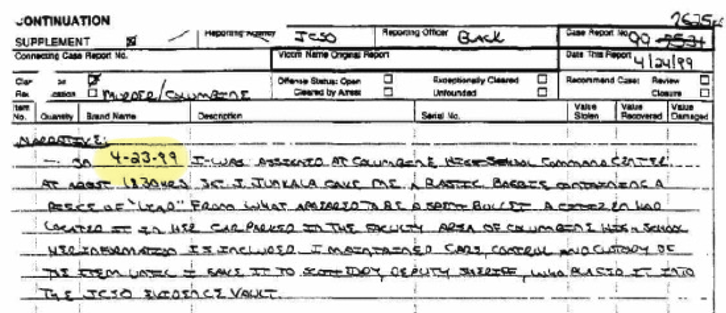
Deputy Kelly Black describes taking possession of a lead fragment.
Source: Quinn Boortz’ interview, 11k, p.2503.
The Blazer was parked in the senior lot, not the faculty lot. However, we know this fragment came from the Blazer because it’s documented on the same page.
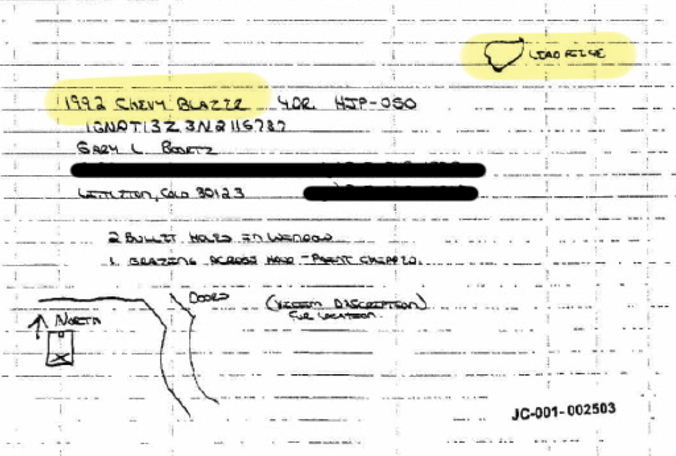
Map depicting the location of the Blazer
Source: Quinn Boortz’ interview, 11k, p.2503.
Did police give Erin access to her vehicle during the investigation before it was released? If so, why? And how did she miss the bullet sitting in plain sight that her father found so quickly?
And if they knew Erin found a lead fragment in the Blazer, why did investigators return the car to her father four days later without collecting any more evidence?
Curiously, there is no interview with Erin Boortz, so officer Black’s claim that she was given a lead fragment in a plastic bag found by the Blazer’s female owner prior to April 23 is unverifiable and without context.
Where was the Blazer parked?
This is a small discrepancy that needs to be cleared up. Officer Black wrote that the Blazer was parked in the faculty lot but Gardner’s alleged shootout took place on the opposite side of the school. The west doors face the senior lot.
Visual evidence places the Blazer in the senior lot. The Channel 4 news helicopter footage shows a white Chevy Blazer parked in the senior lot across from the west entrance, and later footage clearly shows Gardner in his yellow shirt by the hood of that same Blazer with two other officers.
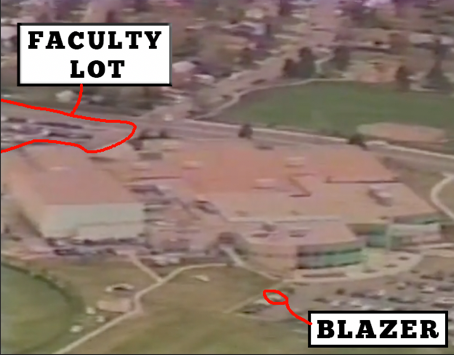
The faculty parking lot is on the opposite side of the school.
Source: Channel 4 news helicopter footage.
The white Blazer seen in the senior parking in the news footage is the Blazer attributed to Gardner’s shootout. So why did investigators document the Blazer as being in the faculty lot?
The hand-drawn map in Kelly’s statement depicts the Blazer parked exactly where it’s seen in the Channel 4 news helicopter footage and in the correct orientation to the school’s doors in a way that wouldn’t line up if it was in the faculty lot.
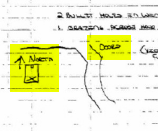
Map depicting the location of the Blazer in the senior lot.
Source: Quinn Boortz’ interview, 11k, p.2503.
The faculty lot reference was likely just a misunderstanding regarding which parking lot was by the west entrance.
Excerpts from the official record:
(1) Neil Gardner describes exchanging gunfire with a suspect at the West entrance
Gardner: “As I’m doing the code thirty-three, I look up and he’s outside of the door, he’s got a flack [sic] jacket on, it was dark colored, I believe.”
Detective Boatright: “How far outside the doors?”
Gardner: “Um, probably a good two feet outside of the southwest doors… white male. Dark baseball cap on. Uh, flack [sic] jacket and a white [T-shirt] … he was holding a rifle… and then, he sees me. And he sees the, the car. Cause, well, it’s not hard to see me in this [bright yellow shirt] and they know what I wear. And, um, he sees me and he pulls the rifle up.”
Detective Boatright: “How far away are you from him?”
Gardner: “Sixty yards. Sixty to seventy yards… when I see him, I move out, I, I’m getting behind the car tire that was right next to my patrol vehicle. Cause I wanted to take cover behind the tire… it was a little Blazer, a mini Blazer… he fired two shots… it hit the Blazer… and then he shoots twice and one hits the, the windshield of the car. The front windshield…
He starts back up with the rifle so I take four quick shots over the hood of the car… I take four quick and I’m back underneath the tire. I’m, my back’s crouched underneath the tire because now he’s shooting a volley.”
Detective Boatright: “How may do you think he has fired at you at this point?”
Gardner: “Uh, six or seven.”
Source: Neil Gardner’s interview transcript, pp.11158-11251.
(2) The Blazer’s legal owner describes finding a bullet ten days after the shooting
“While at the BOORTZ’ residence, Quinn’s father Gary BOORTZ advised the writer that his daughter Erin’s white 1992 Chevrolet Blazer, Colorado license HJP050, had sustained several bullet holes while parked in the school lot. Gary BOORTZ stated that the vehicle was released to him on Friday, April 30 by a trooper from the Colorado State Patrol. BOORTZ pointed out the bullet holes and damage to the trooper. The trooper told BOORTZ that the vehicle had probably been processed, but took photographs. BOORTZ stated that he entered the vehicle and found a relatively intact bullet inside, which he provided to the trooper.”
Source: Quinn Boortz’ interview,11k, p.2505.
(3) The Blazer’s legal owner describes finding a bullet fragment after he got home
“BOORTZ stated that after returning home he began to clean up the interior vehicle, which contained a lot of broken glass. While doing so, BOORTZ found a small piece of what he believed might be a bullet. The writer examined the object, which does appear to be a piece of copper-jacketing from a bullet. BOORTZ advised that he recovered the bullet material from the floor area below the steering wheel. BOORZ stated that he was told that Sgt. Chris Tomford of the Jefferson County Sheriff’s Department would be calling him to pick the object up, but had not received a call.
The writer agreed to take possession of the bullet material and provide it to the Jefferson County Sheriff’s Department. The writer contacted Sgt. Tomford, who advised that she had not been told about the bullet. The writer will be booking the bullet into Jefferson County Sheriff’s evidence.”
Source: Quinn Boortz’ interview, 11k, p.2505.
(4) An officer describes being given a lead fragment found by the Blazer’s female owner three days after the shooting
Reporting officer Kelly Black wrote, “On 4-23-99 I was assigned at Columbine High School command center. At about 1830 hrs. Sgt. J. Junkala gave me a plastic baggie containing a piece of “lead” from what appeared to be a spent bullet a citizen had located in her car parked in the faculty area of Columbine High School.”
Source: Quinn Boortz’ interview, 11k, p.2502.
(5) The lead sheet for Gary Boortz describes the damage to the vehicle
“Vehicle parked in the faculty area of the high school. Two bullet holes in window. One round grazing across hood. One spent bullet recovered and submitted into evidence.”
Source: 10k, p.17837.
(6) Gardner is awarded the Medal for Valor
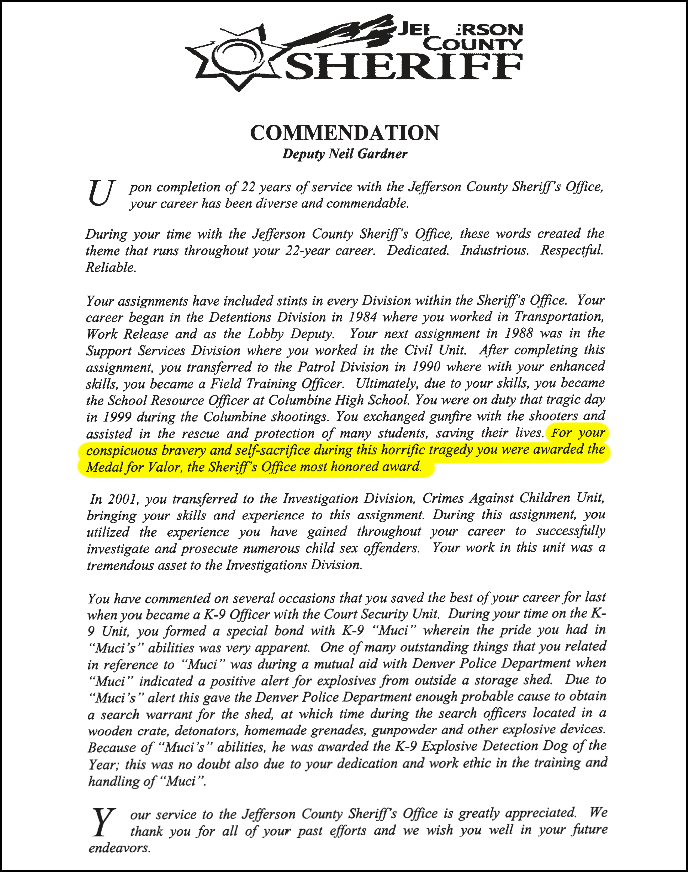
Letter of Commendation for Neil Gardner
Source: Jefferson County.
Gardner Case Anomaly #2:
There’s No Logical Explanation for Why Jefferson County
Determined Harris Was the Rifleman
According to the official narrative, Deputy Neil Gardner exchanged gunfire with Eric Harris at the West entrance before Harris entered the library where he fired through the window at paramedics and police (including Gardner) in the parking lot below.
There are six reasons to question Jefferson County’s identification of Harris.
Reason #1 to Doubt Harris Was the West Door Rifleman
Gardner never identified Harris as the suspect he exchanged gunfire with
In his interview with investigators the evening of April 20, Gardner explicitly stated it wasn’t Harris and was more likely Klebold because the suspect was too tall to be Harris. Gardner would have known their height difference. He had known both Harris and Klebold for more than a year and had been keeping an eye on them after they were reported for detonating pipe bombs in 1997, right around the time he became Columbine’s resource officer.
From Gardner’s interview with Detective Russ Boatright:
Boatright: “Do you know who he is?”
Gardner: “No.”
Boatright: “Okay. Do you believe that he was a student there? I mean, are you saying, do you know everybody that goes to school there?”
Gardner: “I have no idea who he was. Other than he was a, a young adult.”
Boatright: “It’s your belief it was Dylan that you exchanged the gunfire with?”
Gardner: “Correct… just based on the stature of Dylan compared to Eric is a shorter person.”
Source: Neil Gardner’s interview transcript, pp.11158-11251.
After his initial interview, when the official narrative declared Harris the rifleman, that’s when Gardner began naming Harris as the rifleman when retelling his story. He didn’t name Harris because that’s who he thought he saw. For instance:
In an interview with ABC shortly after the massacre, Gardner described the rifleman as Harris:
Gardner: “Eric Harris was wearing some type of blue vest, I don’t know if it was a flak jacket or not, and he was carrying an assault rifle.”
Reason #2 to Doubt Harris Was the West Door Rifleman
Neither Gardner’s nor Marton’s descriptions of the suspect match Harris—and Their Descriptions Are Contradictory
Gardner said the suspect was a white male, about 5’10” to 6” tall, late teens to early twenties, wearing a dark blue flak jacket over a white T-shirt and a backwards baseball cap over light colored, shoulder-length hair.
Campus supervisor Andrew Marton was allegedly riding with Gardner when they pulled into the lot and said the suspect was a white male, about 5’7” to 5”8 tall, 15 to 17 years old, thin, wearing a black backwards baseball hat, a white-shirt, black shoes, blue pants, and a black long sleeved button down shirt unbuttoned. He doesn’t mention a flak jacket or anything about the suspect’s hair.
Did Marton mistake Klebold’s trench coat for a black button down shirt left unbuttoned? And did Gardner just not see the black coat at all?
Harris was 5’8” and was wearing black suspenders over a white T-shirt with no hat, and had buzzcut-short, dirty blonde hair.
Gardner’s description of the suspect matches Klebold more than Harris based on the height, hat, and hair, but Klebold wasn’t wearing any type of vest over his black T-shirt. In fact, Klebold was still wearing his black trench coat when this shootout allegedly took place.
This discrepancy could be explained by the unconscious transference of features between Harris and Klebold. Unconscious Transference is when a witness transfers something already familiar onto a suspect in a way that causes misidentification. It usually happens with faces but can also happen with clothing and physical features.
If Gardner saw the shorter suspect (Harris) wearing suspenders, he might have transferred that onto the taller suspect (Klebold) and confused it for a vest. Likewise, if Gardner saw the taller shooter (Klebold) wearing a backwards hat, he might have transferred that onto the shorter suspect he saw at the West doors (Harris).
However, Gardner claims he only saw one suspect throughout the entire incident, and if that’s true there would be no visual features to mix up.
From Gardner’s interview with Detective Russ Boatright:
Gardner: “Right, I never did see a second suspect.”
Source: Neil Gardner’s interview transcript, pp.11158-11251.
If it doesn’t make sense as to why Gardner would be involved in a cover-up, it should be clear by the end of this dossier. You may want to read this document twice because once you see the whole picture, the discrepancies in Gardner’s description of the suspect seem more like a mixture of what he actually saw and what he was told to say he saw.
One curious thing Gardner left out of his story that Marton describes is the account of the rifleman walking west on the sidewalk while shooting randomly at students in the senior parking lot. Harris did this early on, but long before Gardner’s shootout allegedly took place. If Marton saw Harris doing this, then he was present before the incident began.
Ultimately, Harris doesn’t match Marton’s or Gardner’s description of the rifleman, no other witnesses identified the suspect involved in the shootout as Harris, No other witnesses even saw the shootout, and investigators never processed the bullets the rifleman fired into the Blazer, so how did officials determine the shooter was Harris?
Reason #3 to Doubt Harris Was the West Door Rifleman
Harris wasn’t wearing a flak jacket or dark blue
Neither Harris nor Klebold were wearing a flak jacket during the attack. Harris was wearing black Alice LC-2 suspenders over a white T-shirt, which could have been mistaken for a flak jacket at a distance from the front, but he wasn’t wearing a hat and he didn’t have light colored or shoulder-length hair.
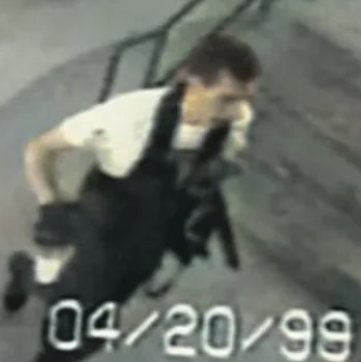
Eric Harris in the cafeteria wearing Alice LC-2 suspenders
commonly mistaken for a homemade bandolier; colorized for contrast.
Source: Cafeteria CCTV footage.
Reason #4 to Doubt Harris Was the West Door Rifleman
Neither Marton’s nor Gardner’s stories match the timestamped library events
According to the official story, Gardner and Marton just finished eating lunch in Gardner’s car by the smoker’s pit in Clement Park when Jay Gallantine, a school custodian, radioed him, “Neil, I need you in the back lot!” (Or “Neil, I need you in the lunchroom!” depending on which version of the story you go with).
Gardner said he activated his lights and siren and arrived in the senior lot at 11:23 a.m. One minute later, he opened his car door and was having a shootout with the rifleman at the west doors. Two minutes later, there was a second shootout, after which the rifleman retreated into the school.
Both Gardner and his passenger, campus supervisor Andrew Marton, said the library windows were already broken out when they arrived in the senior lot, and as they drove up they heard gunfire coming from the library before Gardner even parked his car. If true, that would mean Harris and Klebold were already in the library six minutes too early per the timestamps on Patti Nielson’s 911 call.
If what they reported is true, who was the rifleman at the west doors while Harris and Klebold were shooting up the library?
Neither shooter left the library until they went down into the cafeteria together around 11:40 a.m., which is on video (the official CCTV time reads 11:43 a.m. but we’ll get to the time correction soon). If Gardner arrived after they entered the library, the rifleman he encountered at the West entrance on both occasions couldn’t have been Harris or Klebold.
Curiously, the official story claims that Gardner heard gunshots coming from inside the school but couldn’t identify the location, contradicting his initial interview positively locating them in the library.
If Gardner’s timeline is correct, but he was mistaken about the state of the library windows, the rifleman could have been Harris or Klebold (but not necessarily).
However, as you’ll soon read, attempting to work out Gardner’s true arrival time might be pointless, since Jefferson County Lieutenant Dennis Potter said early on that Gardner was in the school hallway when the incident began.
Potter would know—he was assigned to monitor dispatch communications and had been working for Jeffco for twenty-nine years. And despite Gardner’s claim that he announced his arrival to dispatch, that communication does not exist on the dispatch tape. In fact, three whole minutes have been noticeably cut from the earliest part of the Channel 1 transmissions, including the timeframe that would have established where Gardner was when he got the first call.
How convenient.
As you’ll see later on, Gardner told another story that doesn’t match the evidence, and the timespan in which that story took place has also been cut from the Channel 4 news helicopter footage.
So many coincidences.
Is there a reasonable explanation for Gardner reporting
the library windows broken out upon his arrival?
Let’s say Gardner really was eating lunch by the smoker’s pit and had to drive over to the school to respond to Gallantine’s call. Based on available evidence, and excluding the possibility that he was already in the school, there are only three possibilities that can explain the discrepancy in Gardner’s story about the library windows being shot out and gunfire coming from the library upon his arrival:
(1) Gardner’s timeline is off and he arrived later, closer to 11:30 a.m. (The dispatch tapes and other statements don’t support this)
(2) Gardner arrived around 11:23 a.m. as claimed but both he and Marton were mistaken (or lied) about the library windows already being shot out and shots coming from the library. (His arrival time isn’t supported by the evidence but his story would make sense if he lied about the state of the library windows—but why?)
(3) Harris and Klebold were already in the library at 11:24 a.m. (Patti Nielson’s 911 call along with multiple witnesses don’t support this but it still might be true—take the official documents with a grain of salt. There’s proof that some of the witness statements in the 11k were completely fabricated by investigators, and the publicly released 911 call could have been scripted and recorded ahead of time. This will be explored in a separate dossier)
Approximately three minutes are missing from
the Channel 1 Tape 1 dispatch tape
Analyzing the first Channel 1 dispatch tape reveals that officials cut just under three minutes from the beginning of this tape from at least two different sections. Two cuts are obvious—you can hear the audio cut and the new track start to roll.
The first audible cut happens at 43 seconds, which would be 11:21 a.m. since that’s the time the dispatcher announces two seconds prior.
The second audible cut happens at 55 seconds and the dispatcher doesn’t call out any timestamps until the tape reaches the 2 minute 20 second mark, which is announced as 11:26 a.m. There could be an additional seamless cut during this time since dispatchers don’t usually go five minutes without calling out the time.
The tape begins at 11:21 a.m. and by the time the tape reaches the two minute, 30 second mark, the time should be 11:23 a.m. but the dispatcher is announcing 11:26 a.m.
In addition to Garnder’s initial transmission, what other transmissions were cut from the tape and why?
There’s something else I noticed about the dispatch tapes released to the public. They’re not genuine copies of the tapes. There’s a male in the foreground and a female in the background pressing play on the original tape while recording the audio in sections in the open air using a second tape recorder. There are so many audible cuts that it’s impossible to determine exactly how much time and what time frames have been eliminated.
Why is Gardner’s arrival announcement
missing from the dispatch tape?
Based on the dispatch audio from Channel 1 Tape 1, Garder appears to have been at the school just before 11:23 a.m. but the announcement of his arrival has been cut from the tape released to the public, so there’s no way to verify whether his sudden appearance on the dispatch audio represents him arriving at the school or if he was already at the school.
All the evidence points to Gardner lying about where he was when Gallantine called him on the radio. Gardner was probably already in the school like Lt. Potter said, and Marton likely joined up with Gardner at some point.
In his interview with Detective Boatright, Gardner said he announced his arrival to dispatch:
Gardner: “I said, as soon as I pulled west in the lot, I said seventy-one, I’m on scene.”
Boatright “And so you, your call sign was seventy-one.”
Gardner: “Um hmm.”
Source: Neil Gardner’s interview transcript, pp.11158-11251.
This confirms that Gardner claims he announced his arrival and it should be on the dispatch tape. So, where is it? Gardner’s first transmission—whatever it was—is likely on those three minutes cut from first part of the tape. If Lt. Potter was right about Gardner being in the hall when the incident began, maybe Gardner didn’t announce his arrival, but rather, began communicating to dispatch from within the school.
The entire controversy surrounding Gardner seems to arise from the need to cover up the fact that he was in the school.
Correcting the timestamps
There’s considerable confusion surrounding the timeline because multiple recording systems documented timestamps that conflict with one another, and that don’t match the final timeline published by Jefferson County.
Jefferson County did address the time discrepancies when creating the official timeline but their adjustments aren’t accurate and appear to favor their inaccurate reconstruction of events.
Jeffco claimed:
The Littleton Fire Department dispatch times were four minutes slow.
The school fire alarms were three minutes slow.
Jefferson County 911 calls were 2 minutes and 46 seconds fast.
The cafeteria surveillance tape was already perfect and did not need to be adjusted.
However, the only way the cafeteria footage lines up with the 911 calls is when three minutes are subtracted from the cafeteria tape. Subtracting 2 minutes and 46 seconds from the 911 calls like they suggest makes the cafeteria footage nearly six minutes fast.
Reddit researcher SMBH_7 reconciled this discrepancy by synchronizing events visible on the cafeteria footage with the same events captured in real time on multiple 911 recordings.
This three-minute correction to the cafeteria CCTV footage is critical.
Once Harris and Klebold entered the library, they remained there until approximately 11:40 a.m. (corrected time) when they can be seen heading straight down into the cafeteria.
On the cafeteria surveillance footage, Harris is seen on the lower landing firing over the railing at 11:43 a.m. CCTV time. The actual time was therefore approximately 11:40 a.m. Before then, neither left the library even for a minute to return to the West entrance.
Based on the dispatch tapes, it’s clear that at least one of Gardner’s alleged shootouts with the rifleman occurred prior to the official time Harris and Klebold entered the library, so why did Gardner and Marton both place the shooters in the library upon their arrival? Did the library attack begin earlier? Were there more than two shooters?
Were Gardner and Marton lying?
Gardner’s alleged timeline gets a little messier.
When did the rifleman shoot at Gardner?
Although Marton placed their arrival in the senior lot closer to 11:21 a.m., three minutes after Gardner’s reported arrival time, the first 911 call made that day by student Lindsie Macy appears to confirm Gardner’s arrival at 11:24 a.m. According to the 911 call timestamps, at 11:24:10 a.m., Macy tells the operator, “Uh, cops just pulled up.”
Before going any further, we need to scrutinize Macy’s account. We can’t verify the time Macy noted a police officer’s arrival to the 911 dispatcher because investigators never released her 911 call. We have to consider the possibility that her account may have been fabricated to support the lie of Gardner’s arrival.
Macy’s handwritten report, which doesn’t look like a juvenile female’s handwriting, states the following:
“Ann Marie was screaming ‘I’m paralyzed.’”
This statement makes her whole account suspect.
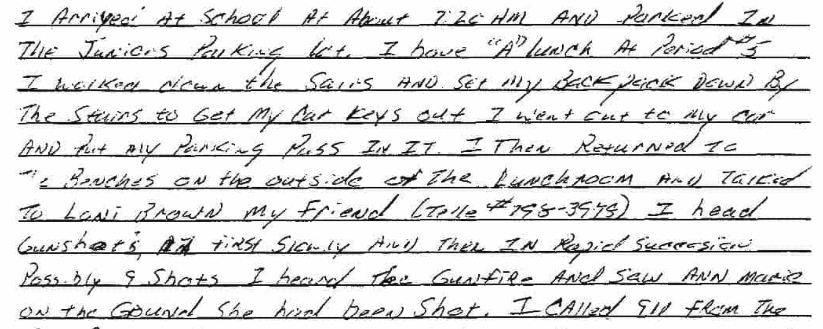
This doesn’t look like a juvenile female’s handwriting.
Source: Lindsie Macy’s interview, 11l, p.983.
The problem is that another witness, Will Beck, claimed to have heard the exact same phrase said by one of two students he saw get shot before Hochhalter was shot.
Beck said he saw two students get shot near the bottom of the stairs and one of them said, “I’m paralyzed.” This would have been Lance Kirklin, Daniel Rohrbough, or Sean Graves, since they were all together and were shot in succession. Christina Redmerski reported that Graves made a similar statement to her while he was in front of the cafeteria door and said, “I can’t feel my legs.”
“At this time Will saw two students get shot. Will stated one said, ‘I’m paralyzed.” Will stated he didn’t know who the students were.”
Source: Will Beck’s interview, 11k, p.689.
Nobody with Hochhalter (Kimberly Blair and Jayson Autenrieth) claimed she said, “I’m paralyzed” or any variation thereof.
Hochhalter was a good distance away from Graves, and Macy was even further away at the pay phone by the Rebel Corner entrance when she allegedly heard Hochhalter say, “I’m paralyzed.”
Below is a photo showing the location of the payphone Macy used next to the Rebel Corner entrance that leads to the cafeteria:
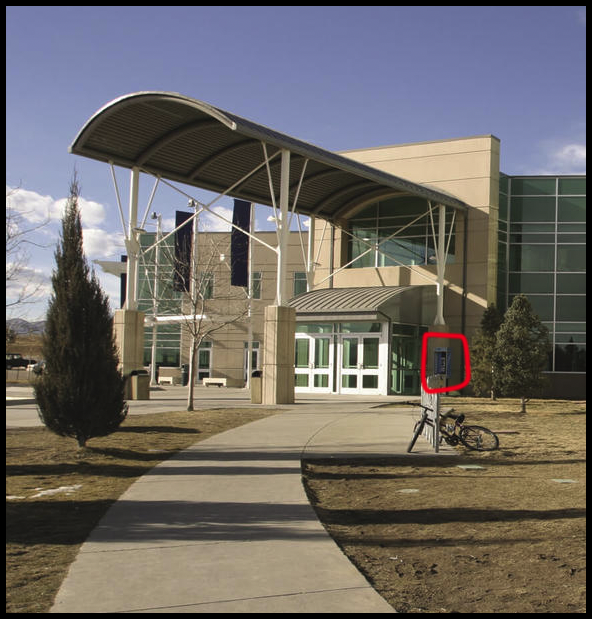
The payphone Lindsie Macy used to call 911 circled in red.
Source: unknown.
Now look at the distance between Graves (G), Hochhalter (H), and Macy (M), and notice how far away Macy was when she claimed to have heard Hochhalter say, “I’m paralyzed.”
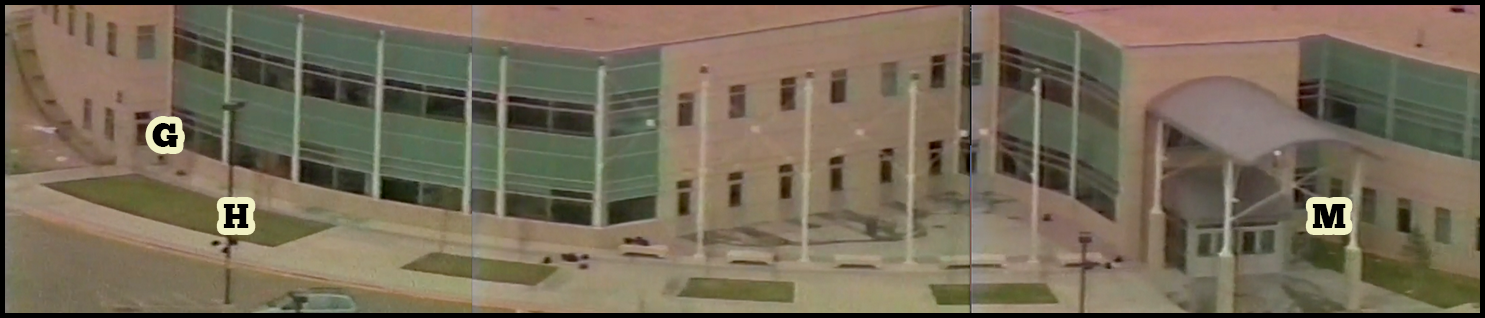
G=Sean Graves, H=Ann Marie Hochhalter, M=Lindsie Macy.
Source: Channel 4 news helicopter footage.
Did Macy really report seeing a cop pull up? If so, was it really Gardner?
If Macy reported seeing a cop pull up it was unlikely to have been Gardner.
Gardner drove an unmarked vehicle with a front spotlight (no overhead lights) and a siren. However, there’s no evidence that the first cop to arrive in a patrol car was Gardner. In fact, there are multiple pieces of evidence that suggest Gardner was already at the school when the shooting began, which would mean a different officer arrived during Macy’s 911 call. The first officer to arrive from elsewhere was likely Deputy Kevin Walker. And interestingly, Walker’s interview contains evidence that Gardner was already at the school when the incident began.
“On 04-20-99, at approximately 1116 hours, dispatch advised of a female party down in the south parking lot of Columbine High School. It started originally as a medical call, and several seconds later, Deputy Neil Gardner advised the party was down due to gunshot wounds.”
Source: Deputy Kevin Walker’s interview, p.8124.
Several seconds after dispatch advised there was a female party down at Columbine, Gardner said it was from gunshot wounds? How would he know unless he was there? This communication would have taken place during the time that was cut from the dispatch tape. Is this just another coincidence?
Deputy Kevin Walker said he responded to the senior parking lot with his lights and siren activated, and said he arrived at approximately 11:29 a.m. Walker parked his patrol car right near Macy’s location.
Below is an image showing the location of the payphone where Macy was talking to the 911 dispatcher (M) and where Walker parked his patrol vehicle (W).
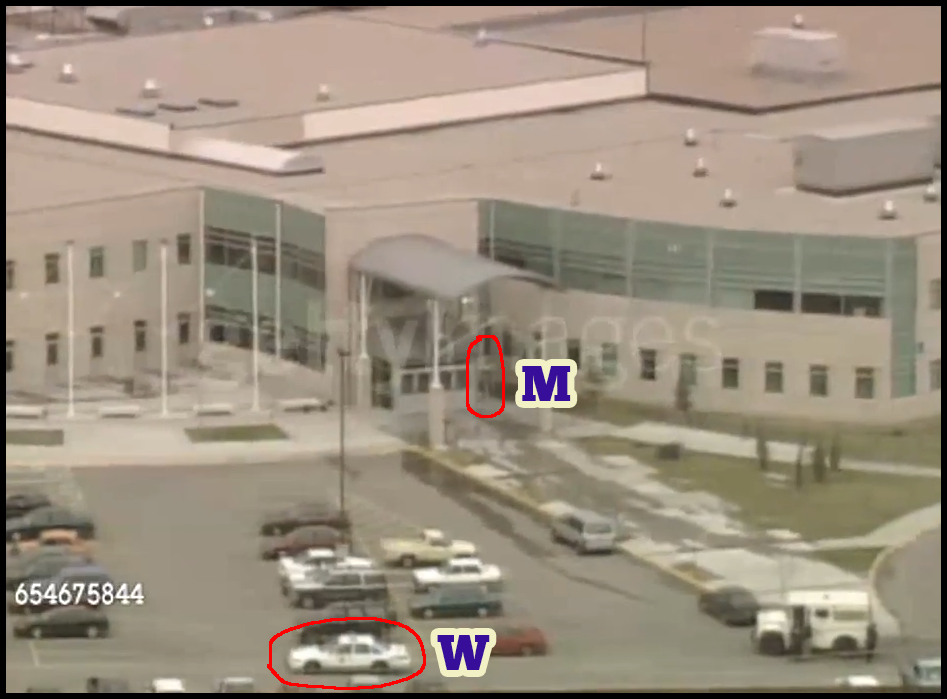
Lindsie Macy’s location during her 911 call (M) and where Deputy Kevin Walker parked (W).
Source: Channel 4 news helicopter footage.
“I drove in the parking lot and went to the second or third row of cars on my right, and parked my patrol car, and exited my vehicle with the shotgun.”
Source: Deputy Kevin Walker’s interview, p.8124.
Walker likely arrived a few minutes earlier and was the officer Macy saw, not Gardner.
Let’s look closer at Gardner’s story.
Gardner: “So at this point I bust the light, lights and siren… I mean my car, it don’t have the overheads but they do have the spot in the middle and on the back.”
Boatright: “And you have the siren.”
Gardner: “Right.”
Source: Neil Gardner’s interview transcript, pp.11158-11251.
The way Gardner recounts “busting” his “lights and siren” and then corrects himself to explain that he doesn’t actually have lights is telling, and a point against the veracity of his claim that he drove into the parking lot from the smoker’s pit.
The 11:24 a.m. arrival time is only possible if you discard Marton’s account of an earlier arrival time, disregard Walker’s account, and ignore Jefferson County Lt. Dennis Potter’s statement that Gardner was already in the school hallway when the incident began.
Gardner’s claim that the library windows were already shot out and shots were coming from the library upon his arrival make it pretty obvious that he’s lying.
Gardner also said he called a Code 33 (officer needs assistance) right as he saw the rifleman exit the west doors, which would have been approximately 11:24 a.m.
The dispatch tape doesn’t support this timeline. According to the dispatch tape, Gardner called a Code 33 at 11:26 a.m., the time he claimed the second shootout was taking place. But he makes it clear to dispatch that he hasn’t encountered a suspect at all yet.
It’s possible that Gardner’s time estimations were off by a couple of minutes. However, there is no plausible explanation for how there could have been a rifleman at the west doors while there was shooting currently going on in the library and had been for a period of time if the rifleman was Harris or Klebold. This makes scrutinizing Gardner’s timeline critically important because it seems like Gardner may have encountered the rifleman somewhere else, perhaps at an earlier time.
From Gardner’s interview with Detective Russ Boatright:
Gardner: “…at the time I’m doing the code thirty-three, the suspect comes out the doors that had been shot out. He steps outside of the door.”
Boatright: “Okay, had you seen the shooter up to this point at all?”
Gardner: “No… As I’m doing the code thirty-three, I look up and he’s outside of the door, he’s got a flak jacket on, it was dark colored, I believe.”
Source: Neil Gardner’s interview transcript, pp.11158-11251.
It’s possible that Gardner was mistaken and the first shootout occurred at 11:26 a.m., while the second occurred around 11:28 a.m., but what doesn’t track is the fact that even if that were true, dispatch says Gardner is still under fire at 11:32 a.m. The rifleman didn’t engage Gardner for that long. Also, by 11:32 a.m., Harris and Klebold had been in the library for a while.
A transmission on the Channel 2 tape comes from #135 (an unknown deputy) who tells the dispatcher he thought Gardner said he was under fire. The dispatcher says, “that’s confirmed, he said he’s under fire in the back student lot.” Then on Channel 1 Tape 1, the dispatcher announces, “71 is still under fire in the south lot.”
71 was Gardner’s radio identification.
Right before this transmission regarding Gardner being under fire, on Channel 1 Tape 1, Deputy Edward Pearson, #145, advises the dispatcher that he is watching a suspect in a holster vest in the library who just walked by a window. That sounds like Harris. So, who’s firing at Gardner while Harris is in the library being observed by Pearson? Or did the rifleman retreat into the school and enter the library like Gardner stated, and the dispatcher’s relay of events was just a little late?
On the Channel 2 tape right before Pearson tells the dispatcher he thinks Gardner said he’s under fire, it sounds like Gardner says, “I’m holding fire. He went back into the building.” This could have been mistaken for “I’m under fire.”
On the Channel 2 tape, at what would be approximately 11:32 a.m., the dispatcher asks Gardner for his location. Gardner responds, “I’m in the back student lot.” After that, Gardner goes silent for over 20 minutes.
Perhaps Gardner never said he was under fire at 11:32 a.m. But no matter which timeline you use, and no matter which adjustments you make, the times and durations don’t line up with Gardner’s story.
While dispatch timestamps support the possibility of the rifleman being Harris or Klebold, there’s no plausible time window in which either Harris or Klebold could have been the rifleman shooting at Gardner at approximately 11:32 a.m., nor could a rifleman have shot at Gardner after the library windows had been broken out.
So, who was the rifleman Gardner exchanged fire with? And was there actually a shootout at the West entrance?
Reason #5 to Doubt Harris Was the West Door Rifleman
Gardner believed he shot the suspect in the right upper shoulder but Harris wasn’t injured
Gardner was fairly certain he struck the suspect in the upper right shoulder during their exchange, which caused the suspect to spin around in a circle. And as you’ll soon see, one of Gardner’s bullets apparently went completely through flesh. So, we know he shot someone. According to the autopsy reports, neither Harris nor Klebold had any gunshot wounds (other than self-inflicted).
It was rumored that the shooter was Harris and Gardner hit the rifle’s magazine but that’s not possible. None of the Hi-Point rifle’s magazines were damaged by a bullet, and when inserted, a Hi-Point magazine disappears completely into the magazine well. There was no recorded damage from a bullet to the magazine well.
If you look closely at Harris in the photo below, you’ll see that if Gardner shot him in the upper right shoulder, he wouldn’t have had any protection. The still image below was taken from the cafeteria CCTV footage after the shootout, and there’s no visible blood on Harris’ shoulder. The small spot visible on his shirt sleeve isn’t consistent with a bloodstain from any kind of gunshot wound, let alone a .45-caliber hollow point.
Eric Harris in the cafeteria wearing Alice LC-2 suspenders
commonly mistaken for a homemade bandolier; colorized for contrast.
Source: Cafeteria CCTV footage.
Recovered ballistic evidence published in the El Paso County report confirms Gardner’s claim that one of his bullets did hit someone in the flesh in front of the west doors. But it wasn’t Harris or Klebold. We’ll explore this in detail in anomaly #3.
But before we move on, it’s critical to ask if the rifleman could have spun around in a circle while crouched. Try it out. I’m not that flexible so maybe it’s just me but I can’t spin in a circle while crouched without falling over.
Did a third shooter wearing a blue flak jacket get away?
Reason #6 to Doubt Harris Was the West Door Rifleman
A bullet-riddled blue vest was abandoned in a science room
Gardner said the rifleman he exchanged fire with was wearing a blue flak jacket, and Gardner believed he shot that suspect. Investigators later recovered what they described as a “blue vest” with bullet holes” hanging in a science room with a bullet and fragment visible on the vest:
JCSO evidence #1603: “bullet and fragment on vest – caution.”

Source: Evidence Volume I, Scene Recovery Log, p.11309.
The computerized evidence log documents the item as a blue vest with bullet holes:

Source: Evidence Volume I, Computerized Evidence Log, p.11616.
We don’t know how many bullet holes were in the vest, or if any bullets were embedded in any of those holes. But this is a massive coincidence that deserves a closer look.
This vest was documented but never explained. There’s no evidence that it was a flak jacket, and there’s no established evidence proving that this was the same vest Gardner described seeing on the suspect. But the presence of a blue bullet-riddled vest abandoned by somebody in a science room does line up with the possibility that Gardner exchanged fire with—and shot—a suspect who was neither Harris nor Klebold.
Could the bullet on the blue vest be one of Gardner’s missing bullets? If the documented bullet and fragment were tested, the results were never released.
The recovery of a bullet-riddled blue vest doesn’t prove it belonged to the rifleman, but if the rifleman wasn’t Harris or Klebold as the evidence suggests, then this vest becomes critically important.
The bullet-riddled vest was omitted from the evidence maps
Investigators didn’t document the exact science room where the vest was found in the evidence logs, and they didn’t plot the evidence number on the ballistic map released to the public. However, based on sequential evidence numbering, it was likely found in the science office next to SCI-3.
The blue vest was assigned evidence #1603. Evidence from science office #1 begins at #1590 and goes up to #1608. Several pieces of evidence in the sequence were omitted from the map, including the blue vest.
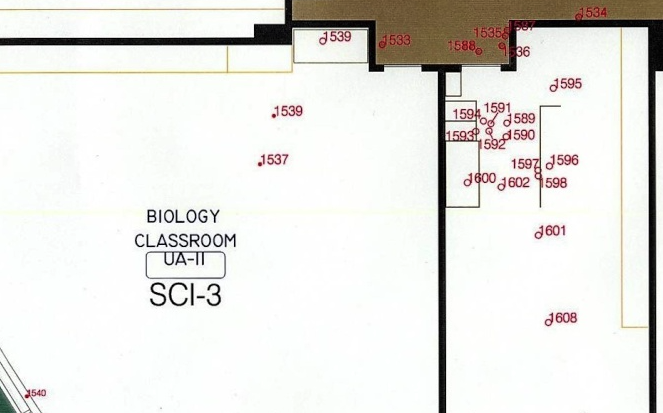
A crime scene diagram showing evidence numbers in SCI-3 and Science office #1.
Source: Jefferson County.
Below is an unreleased crime scene photo of the Science office. Notice it has plenty of shelves (the vest was found hanging from a shelf):
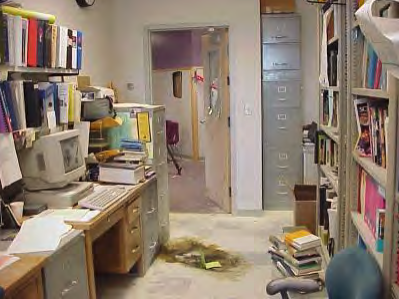
A crime scene photo of Science office #1 where teacher
Theresa Miller extinguished a Molotov cocktail.
Source: Jefferson County.
It should be noted that there is a direct path from the West entrance to the science wing where the blue vest was found. The rifle suspect could have easily ditched his blue flak jacket in the science office when he retreated into the school.
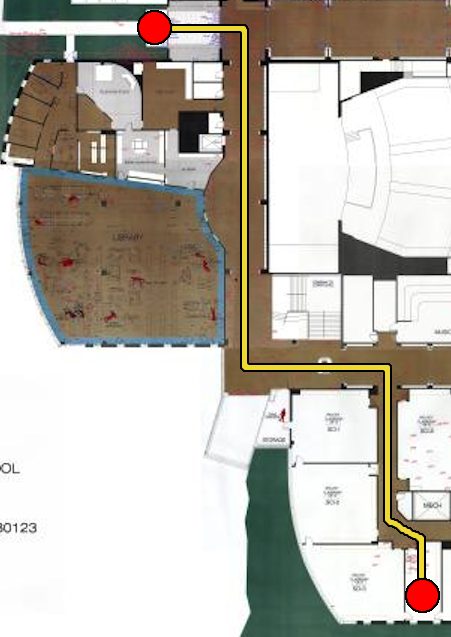
The path from the West entrance (top red dot) to the science office
where the vest appears to have been found (bottom red dot).
Source: Jefferson County.
It’s entirely possible that an additional shooter was wearing a blue flak jacket and ditched it in the science office after retreating into the school. It’s also possible that investigators omitted the vest’s evidence number from the publicly released maps to conceal the existence or identity of said shooter. It’s also possible that the blue vest entered into the evidence logs was fake, and was intentional misdirection to make anyone who found it believe it was the vest worn by the rifleman.
Could this vest have been the rifleman’s vest? I don’t think it was. I think the rifleman’s identity has been in plain sight all along, and since day one we’ve had a photo of the rifleman still wearing his bulletproof vest that went unnoticed until recently. This will be addressed in Anomaly #3.
Excerpts from the official record:
(1) Gardner describes hearing gunfire from the library and seeing the windows already shot out as he arrives in the senior lot
Upon arrival, Gardner notices a puff of smoke and drives toward it.
Gardner: “It’s not ‘til I turn back towards the building that I see some windows shot out… Then I get to the, as far west as I can go, then I turn back up the north in the lot. The very last row in the lot. And then I hear gunfire. Coming from the library area. Which is the upper area of the school.”
Boatright: “You got your windows down?”
Gardner: “Um hmm.”
Boatright: “And you see one of those windows break out.”
Gardner: “Well no, it was alr-, I didn’t see the glass fall out, it’s, it’s out.”
Boatright: “Okay, it’s broken. It’s gone.”
Gardner: “It’s gone… big hole in it. There’s jagged edges around it.”
Boatright: “…then you start hearing what you think is gunshots at that point.”
Gardner: “Right. Rapid fire gunshots.”
Boatright: “How many do you think you heard?”
Gardner: “Eight to ten.”
Boatright: “Where are they coming from?”
Gardner: “Upper library area.”
After that, Gardner tells Marton to lay on the floor of the car, passenger side, and then explains that at that point he understood that there was a possibility that he could become under fire at any minute. The shooters are in the library actively shooting out of the windows when Gardner pulls up, and he hasn’t even seen the rifleman yet. He then looks at the West entrance and sees the glass in the doors has been shot out.
At that point, he radios a Code 33 (officer needs assistance) to the dispatcher. While he’s radioing the code 33, he sees the suspect come out of the west doors. If the suspect were Harris or Klebold, that means one of them left the library when it’s documented that they did not leave.
Gardner: “…at the time I’m doing the code thirty-three, the suspect comes out the doors that had been shot out. He steps outside of the door.”
Boatright: “Okay, had you seen the shooter up to this point at all?”
Gardner: “No… As I’m doing the code thirty-three, I look up and he’s outside of the door, he’s got a flak jacket on, it was dark colored, I believe.”
Source: Neil Gardner’s interview transcript, pp.11158-11251.
(2) Marton describes hearing gunfire from the library as he arrives in the senior lot and seeing windows breaking
“Marton advised at about 1121 AM heard shots and saw a cloud of smoke at the SW corner of the senior parking lot. Marton advised Dep Gardner drove to SW corner of lot and they got out and took cover by a white Blazer.
Marton said he could hear shooting in library to include windows breaking and gun flashing.”
“Marton stated they went into the senior parking lot. Marton also stated that he could hear the gunfire coming from the area of the library in their direction. Marton stated the gunshots appeared to be from a shotgun and a smaller caliber type weapon.”
“Marton said after about 15 or 20 seconds, after the gunman retreated from the west doors, the windows in the library began to break out. Marton stated again that him and Deputy Gardner were taking gunfire from the library.”
“Marton stated he followed Deputy Gardner, hiding just to the rear of Deputy Gardner. Marton stated at this time, he was hearing gunshots in the library, and observed gun flashes and windows breaking.”
“Marton stated while maintaining cover outside behind the white Blazer in the senior parking lot, that he heard approximately six to seven shots inside the library.”
Source: Andrew Marton’s interview, 11k, pp.991-998.
(3) Gardner explains that he can’t identify the rifleman
Boatright: “Just so I can clarify this, do you recognize this person you’ve shot at?”
“No.”
Boatright: “Do you know who he is?”
Gardner: “No.”
Boatright: “Okay. Do you believe that he was a student there? I mean, are you saying, do you know everybody that goes to school there?”
Gardner: “I have no idea who he was. Other than he was a, a young adult.”
Boatright: “Okay. He could have been a student.”
Gardner: “Whatever. Yeah. I don’t know if he’s a student or, or what.”
Boatright: “Okay. You didn’t get a good enough look at him to identify him.”
Gardner: “No.”
Source: Neil Gardner’s interview transcript, pp.11158-11251.
(4) Gardner describes the suspect
Gardner: “Light colored hair, um, it wasn’t too long, I guess it was about to here” (collar length)
Boatright: “You’re talking white male?”
Gardner: “Flack [sic] jacket, blue, dark blue. And a white t-shirt on underneath.”
Gardner: “Yeah, a baseball cap on backwards.”
Boatright: “Do you know the color?”
Gardner: “No.”
Gardner: “It was a darker color.”
Boatright: “About how tall was this person?”
Gardner: “Five-ten, six foot. He was pretty tall.”
Boatright: “Okay, uh, weight?”
Gardner: “Skinny.”
Source: Neil Gardner’s interview transcript, pp.11158-11251.
(5) Marton describes the suspect
“Marton described the gunman as a white male, 15 to 17 years of age, approximately 5’07” to 5’08”, thin build, wearing a black baseball hat (backwards), a white t-shirt, a black long sleeved button down shirt (unbuttoned), which was approximately down to his thigh, light blue pants, black shoes (unknown type), carrying a long rifle on his right side hip level, walking west up the sidewalk from the west doors, shooing randomly at students in the senior parking lot.”
Source: Andrew Marton’s interview, 11k, pp.991-998.
(6) Gardner describes seeing the rifleman suspect in the library just a few minutes after the second shootout at the west doors
Gardner: “And the next time I see the suspect which is, I mean we’re talking just a few minutes later after this last volley, you can see him in his flak jacket up in the library and that’s when the DPD officers and I don’t know who else, I didn’t shoot anymore, they started shooting at the upper window.”
Boatright: “Is this the same guy do you think that you engaged initially?”
Gardner: “I think that it’s the same guy.”
Boatright: “Right, I never did see a second suspect.”
Source: Neil Gardner’s interview transcript, pp.11158-11251.
The only time Harris and Klebold left the library was when they went down into the cafeteria, which was captured on video. The rifleman Gardner saw at the west doors couldn’t have been Harris or Klebold.
(7) Marton describes hearing gunshots in the library just after the second shootout at the west doors
“Marton said the gunman then started shooting again hitting the vehicle they were using for cover. Marton said the gun fired from between the west doors. Marton said the gunman went back inside and gunfire started from library.”
Source: Andrew Marton’s interview, 11k, pp.991-998.
(8) Marton describes hearing gunshots in the library just after the first shootout at the west doors
In his second interview, Marton describes the same scenario: the rifleman walks west along the sidewalk and shoots at students in the senior lot, the rifleman retreats, and Marton hears shots fired from the library. But this time he merges the shootouts into one event and says he heard shots coming from the library right after Gardner called a Code 33. According to both Gardner and Marton’s original interviews, the second shootout was the event that followed Gardner’s Code 33. Not shots in the library.
“Marton stated Deputy Gardner drove his vehicle to the southwest corner of the parking lot and advised the dispatcher (Code 33).
Marton stated he observed the gunman come out of the west doors upper level. Marton described the gunman as a white male, 15 to 17 years of age, approximately 5’07” to 5’08”, thin build, wearing a black baseball hat (backwards), a white t-shirt, a black long sleeved button down shirt (unbuttoned), which was approximately down to his thigh, light blue pants, black shoes (unknown type), carrying a long rifle on his right side hip level, walking west up the sidewalk from the west doors, shooing randomly at students in the senior parking lot.
Marton said after about 15 or 20 seconds, after the gunman retreated from the west doors, the windows in the library began to break out. Marton stated again that him and Deputy Gardner were taking gunfire from the library. Marton estimated 6 to 8 shots, by what he described as a gunshot and two from a rifle.”
The content of Martons stories match between his interviews but the order of events he tells in his second interview describes the first shootout, Gardner’s Code 33, followed by the suspect’s entry into the library, completely skipping the second shootout.
Source: Andrew Marton’s interview, 11k, pp.991-998.
Gardner Case Anomaly #3:
Ballistic Evidence Suggests Gardner Shot Someone
Who Never Acknowledged Being Shot
Although Gardner said he wasn’t certain he hit the rifleman, the evidence indicates he shot someone.
A mushroomed bullet traced to Gardner’s gun
was found several feet in front of the West doors
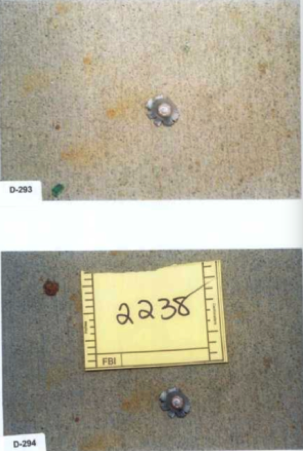
The mushroomed bullet traced to Gardner’s pistol
found several feet in front of the West doors.
Source: The El Paso Report.
The existence of this mushroomed .45 ACP bullet is problematic because it confirms that Gardner shot someone at the West doors. A firearms/ballistic expert who examined the photo of this bullet concluded that its deformation is consistent with having passed through flesh and not a wall or glass. They explained that fluid dynamics indicate that this bullet passed through flesh because .45-caliber hollow point bullets don’t expand when they pass through drywall. The drywall clogs the tip and prevents expansion. Even clothing can clog a hollow point and prevent expansion.
It is possible for a hollow point to expand when passing through plywood but there was no source of plywood in the area.
This bullet would have created a through-and-through wound and that would be consistent with Gardner’s perception that he shot someone in the shoulder. Hollow points tend to slow down and remain inside a body, but the distance a hollow point bullet would need to travel through an arm or shoulder to create a through-and-through wound is considerably less compared to a torso.
The mushroomed bullet is evidence #2238 and
was recovered in front of the West doors:
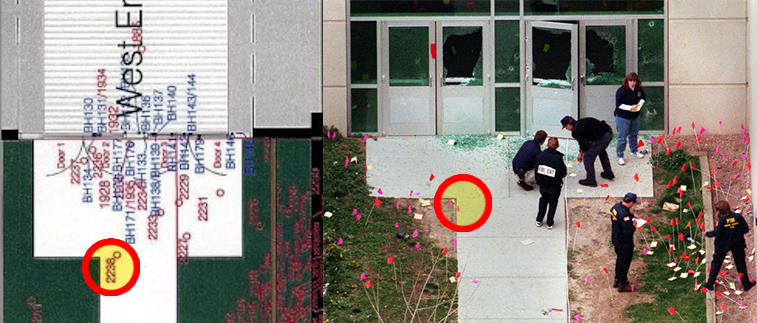
Left: Evidence map marked with Gardner’s mushroomed bullet, item #2238.
Right: Photo of investigators processing the scene.
Source: Jefferson County.
Since Harris and Klebold didn’t have any gunshot wounds that were not self-inflicted, Gardner had to have shot someone else in front of the West doors. But who? Was it the rifleman or someone else?
Gardner Case Anomaly #4:
Gardner Referred to the Rifleman As “Scott”
The identity of the rifleman might be more transparent than it seems. During his taped interview, Gardner curiously referred to the rifleman at the West doors as “Scott.”
This wasn’t necessarily a random a slip of the tongue.
Gardner stated in his interview that he could recognize Klebold but “couldn’t recognize Scott.” This comment suggests that Gardner either already knew the suspect’s name was Scott, or someone informed Gardner later on that it was Scott.
There are two individuals named Scott who were on the West side of the school at that time, and a third Scott that deserves some scrutiny. However, one Scott matches the description of the rifleman down to the bulletproof vest: Larry Scott Petty, Jr.
Scott #1: Larry Scott Petty, Jr.
Police reported capturing a 27-year-old man named Larry Scott Petty (he went by “Scott”) whom they claimed was walking toward the school carrying a rifle while wearing a white T-shirt and ball cap with a “Rambo knife” strapped to his leg. He was 5’10” with dirty blonde hair.
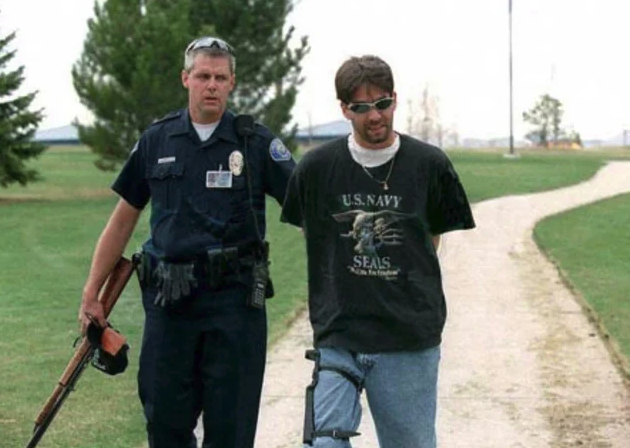
Lakewood SWAT Agent Randy McNitt apprehending Larry Scott Petty, Jr.
Source: Rocky Mountain News.

Petty went by Scott as a first name.
Source: 11k, p.7661.
Petty matches the description of the rifle shooter on nine points: name, height, age, shirt, pants, cap, hair color, general location, and possession of a rifle. In the above photo you can see that he’s wearing a black t-shirt over a white t-shirt. It’s unknown where his hat went before this picture was taken.
Petty was wearing a ball cap just like the rifleman
According to Deputy Lorrie Brovsky, who assisted with Petty’s arrest, Petty was wearing “a black t-shirt and ball cap with a [sic] Navy Seals logos on them. He also had on blue jeans and black combat boots.”
Source: Lorrie Brovsky’s interview, 11k, p.9773.
Petty was wearing a white t-shirt just like the rifleman
Deputy Bob Byerly saw Petty prior to Brovsky said Petty was wearing a white t-shirt. This suggests that Petty put the black shirt on over his white shirt after he was spotted by Byerly but before the above photo was taken.
“Deputy Byerly reports that a male wearing a white shirt and black pants is walking on the west side of the school. The young man had heard of the shooting on TV and ran through Clement Park towards the school carrying an unloaded .22 Caliber rifle and a knife in order to “help the police.” He subsequently is contacted at gunpoint.”
Source: Jefferson County Sheriff’s Office final report, Narrative Time Line of Events, 12:00 noon to 5:00 pm.
Why would Petty put on a black shirt?
Take a close look at the square outline underneath Petty’s shirt for the most likely answer:
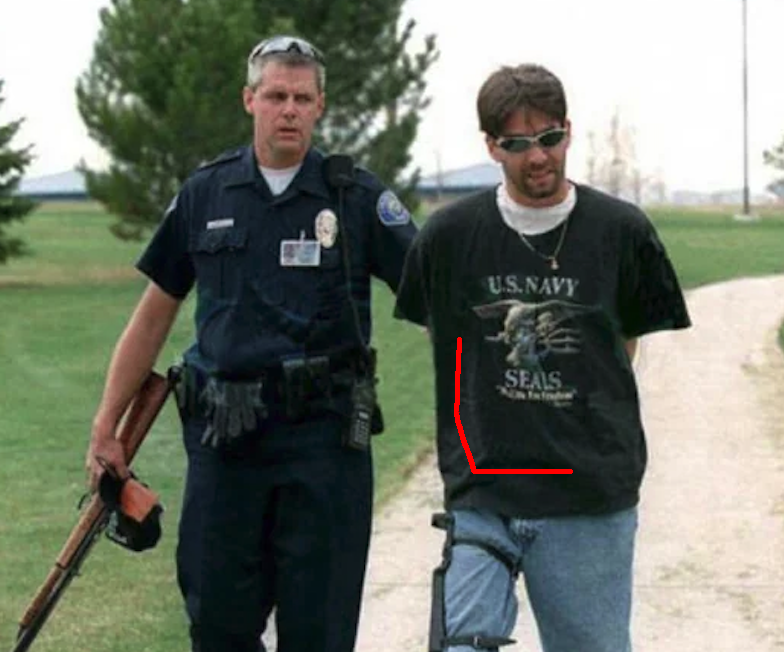
There’s something with squared edges visible underneath Petty’s shirt.
Source: Rocky Mountain News.
An outline resembling plate armor is visible under Petty’s shirt. Did Petty put on a black shirt to hide his body armor?
It certainly looks like Petty is wearing body armor underneath his shirt. And it looks like he’s wearing some kind of swimmer’s cut. If that’s a bulletproof vest, the plate is sitting pretty low on his chest, which means he may have loosened the shoulder straps to let it drop to make it less obvious. Or it was already sitting low on his body.
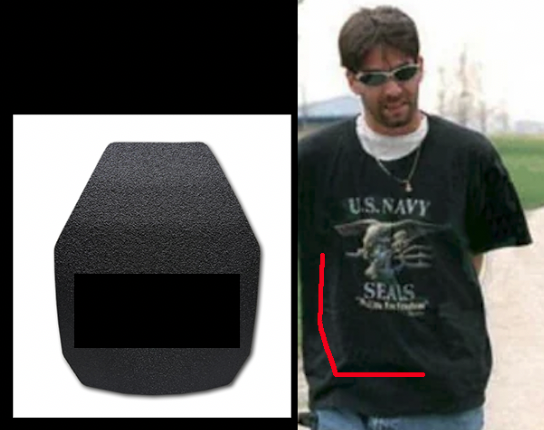
Petty appears to be wearing body armor under his t-shirt.
Credits go to Nick (lemonbeats303 on Reddit) for noticing this.
Source: Rocky Mountain News.
The shape under Petty’s shirt isn’t typical for standard plate cuts. Most plates don’t angle outward from the bottom up but some swimmer’s cuts do. The plate image to the left of Petty in the above image is a swimmer’s cut.
If Petty was wearing body armor, which appears to
be the case, wouldn’t police have noticed?
Yes, if officers detained, searched, and physically handled Petty in any way, his body armor would have been extremely difficult to miss. And that’s why this point matters so much. It doesn’t seem like Petty was just a random person who happened to resemble the rifleman. My contention is that the officers who handled him already knew about his armor because the rifleman situation was staged and Petty played that role.
It’s possible that once he was done with his main rifleman role, he drove to the public library, parked, got out of his car carrying a BB gun while pretending to head to the school, and police pretended to intercept him as a suspect. A photographer from the Rocky Mountain News just happened to be at the public library a half mile away from the school and snapped a perfect picture of Petty’s “perp walk.”
The easiest way to convince the public that a perpetrator is innocent is to make them an official suspect immediately and then clear them quickly. That’s exactly what they did with a handful of suspicious people with bogus stories, including Brooks Brown, Chris Morris, and the Splatterpunks. Making Petty look like a total geek who thought he was going to “help law enforcement” stop a mass shooting with an old, unloaded BB gun made him look incompetent, which made it easy to clear him so nobody would look into him any further.
There is no statement from Petty’s arresting officer Randy McNitt
Curiously, officials never released a statement from Randy McNitt, the officer who initially contacted and arrested Petty. We’re also missing a statement from one of the only two students known to have witnessed Petty’s arrest. Brandon Williams was with Michael Baribeau in Clement Park when Baribeau saw Petty being taken into custody, but no statement from Williams has been released.
From Baribeau’s interview:
“Walked around Clement seeing a male with long "shot gun" then police got him. I know of the man did not see face."
Source: Michael Baribeau’s interview, 11k, p.2411
What did he mean by “I know of the man?” He knew Petty? From where?
From Baribeau’s second interview:
"He saw a policeman confront a kid carrying a weapon, which he found out was a BB gun."
Source: Michael Baribeau’s interview, 11k, p.2413
Where was Petty taken into custody?
Before going any further we need to establish where Petty was when he was arrested. Many people mistakenly believe he was captured near the school because he was detained near a soccer field, but he was actually taken into custody about 50 yards from the public library parking lot a half mile away.
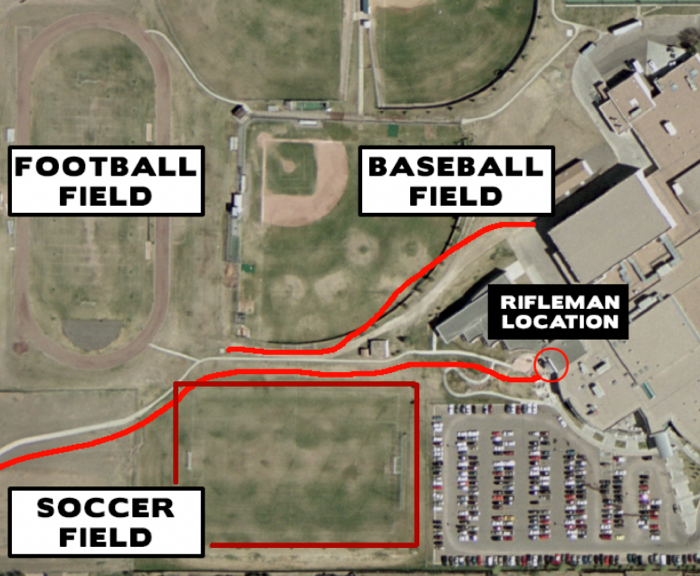
Aerial showing Columbine’s soccer field.
This is nowhere near the public library bordering Clement Park.
Source: Google Maps.
Now let’s establish who took Petty into custody:
Bob Byerly—Saw Petty first wearing a white shirt.
Randy McNitt—Physically took Petty into custody.
Lorrie Brovsky—McNitt handed Petty over to her.
Bob Swainson—Assisted with Petty’s arrest.
Brent Sawyer—Assisted with Petty’s arrest.
Deputy Brovsky said she helped officer McNitt take Petty into custody by the soccer field. She’s referencing the soccer field in Clement Park, which is a half mile from the school.
According to Lakewood SWAT agent Bob Swainson, he and Agent Brent Sawyer helped Brovsky and McNitt take Petty into custody on the northwest corner of Clement Park. This is where the public library is located.
This can be confirmed by looking at the Rocky Mountain News photo of McNitt and Petty, which has been taken deep inside Clement Park.
“On Tues. 04-20-99 at about 1200 hrs. Agt. B. Sawyer & I responded to Columbine H.S. 6200 S. Pierce St. in regards to shots fired @ the school. Once on scene we were detailed to assist in securing a perimeter on the N/W corner of Clements [sic] Park. During this time we assisted Agt. McNitt & a female Jeffco Deputy take into custody a 27 Y.O.A. W/M who had armed himself with a BB rifle & Rambo knife and who was en route to the school to assist police. He was put in the Deputy’s car & held for investigation.”
Source: Bob Swainson’s interview, 11k, p.8651.
McNitt told Detective Tom Hayes that he intercepted Petty near the Columbine Public Library where he was establishing a perimeter. Petty told Detective Hayes that he parked at the public library and only made it 50 yards before being contacted by law enforcement.
“…and drove his white Toyota Tacoma pickup truck to the pavilion at the Jefferson County library parking lot where he parked and attempted to approach the school. Petty said that he only got approximately 50 yards away from his vehicle when he was contacted by a police officer who took him into custody.”
Source: 11k, Agency Reports, Lakewood P.D., pp.9068-9069.
This account is supported by Lakewood SWAT agent Richard Halpin.
“I was then asked to establish a perimeter along the north side through clement Park. I selected Agt’s Ruybal, McNitt, Garcia and myself and walked W/B through the park. Agt. McNitt had started W/B while I was collecting the other agents and encountered a subject approaching the school from the public library parking lot carrying a rifle. See report by Agt. McNitt.”
Source: Richard Halpin’s interview, 11lk, Agency Reports, Lakewood P.D., p.9065
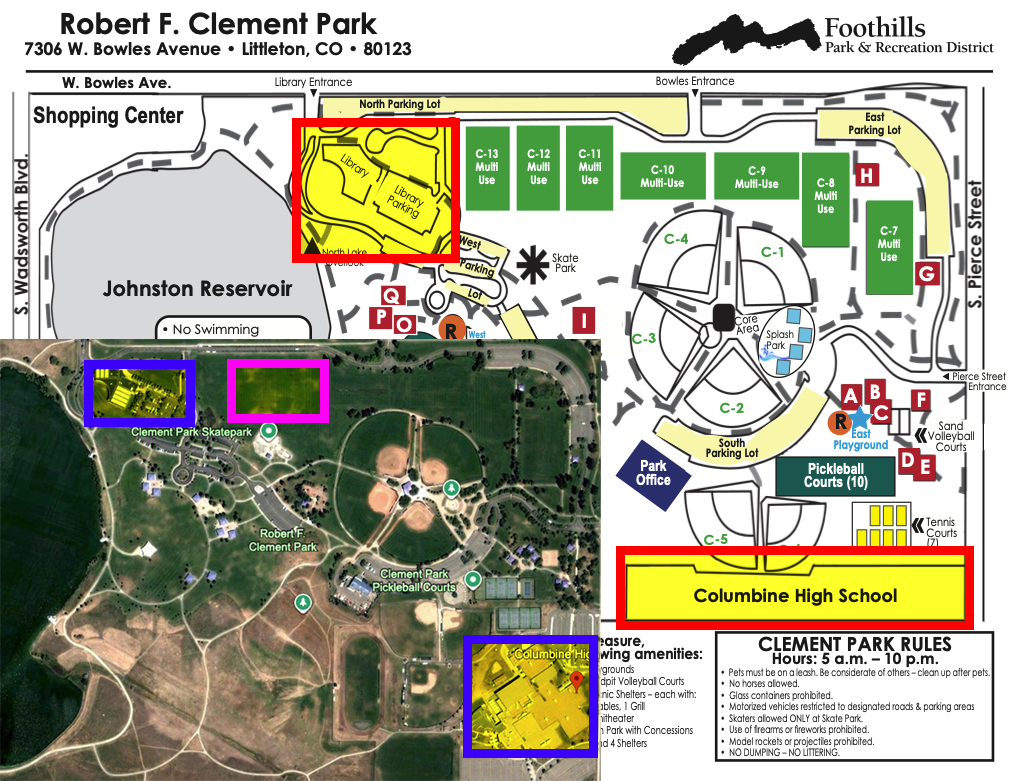
A map of Clement Park showing Columbine in relation to the public library and
A Satellite image of the soccer field next to the library (purple rectangle).
Source: Foothills Park & Recreation District & Google Maps.
What time was Petty taken into custody?
Now that we’ve established where Petty was arrested, it might seem impossible for him to have been involved in a shootout with Deputy Gardner at 11:26 a.m. only to be arrested in the parking lot at the public library seven minutes later. But Petty could have easily left the school in his car and parked at the library.
Here’s a map showing the distance between the west doors where the rifleman was, and the public library parking lot where Petty was captured. The total bird’s eye distance is about 0.5 miles.
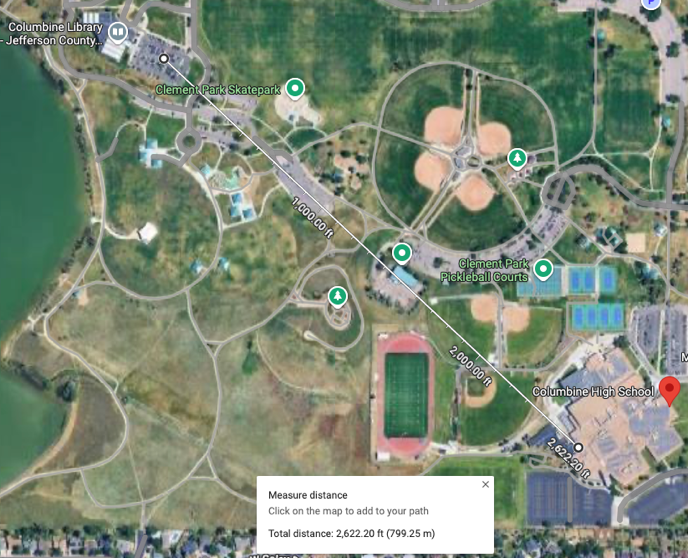
The distance between the west doors and the public library is about 0.5 miles.
Source: Google Maps.
It takes the average person about ten minutes to walk half a mile. Walking on the paths would take around 15 minutes. In order for Petty to have been arrested at around 11:33 a.m., he would have had to either start walking to the library parking lot exactly when Gardner claims the rifleman retreated into the school, or get in his car and drive there. However, there’s no need to try to work out this timeline because Petty couldn’t have been arrested at 11:33 a.m.
McNitt, the officer who arrested Petty, was dispatched to the scene at 11:37 a.m. and didn’t arrive until 12:09 p.m., thirty-two minutes later. That means Petty couldn’t have been arrested prior to 12:09 p.m. If Petty was the rifleman and disappeared into the school at 12:26 a.m., he would have had more than 40 minutes to put on a black shirt, escape from the school, and either walk or drive over to the public library, wait for his cue, and pretend to get arrested.
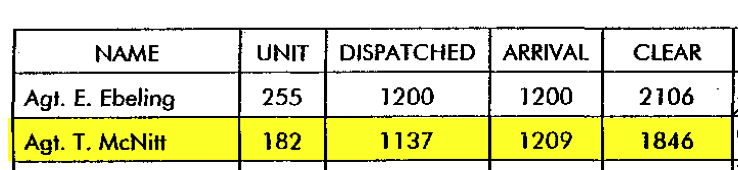
McNitt’s dispatch and arrival times.
Source: 11k, Agency Reports, Lakewood P.D., p.9044
Brovsky, the officer who assisted McNitt with Petty’s arrest, wasn’t there at 11:33 a.m. either. She arrived on the scene in a different location around 11:35 a.m. and heard gunfire coming from a nearby bush. She relocated to an area near the soccer field in Clement Park and shortly afterward encountered McNitt taking Petty into custody. Her account also places Petty’s arrest well after 11:33 a.m. but still before the arresting officer McNitt arrived on scene.
Interestingly, dispatch audio records a subject who appears to be Petty walking toward the school around 11:42 a.m. from the ballfields. However, he is reported to be unarmed.
At around 11:42 a.m., MC2 (Deputy Paul Smoker) spotted an unarmed individual matching the general description of Petty walking toward the school and Taborsky can be heard saying someone needs to make contact with him so they can maintain their perimeter.
Smoker: “We’ve got a party walking on the baseball fields, northwest side of the building.”
Dispatcher: “Okay, does he have any weapons or body armor that you can see?”
Smoker: “He’s wearing blue jeans, dark shirt, that’s all I can see. He’s headed to the school.”
Source: Dispatch Channel 1, Tape 1.
There’s no indication on the dispatch tape regarding if or when this individual was contacted. However, if the individual was Petty, this is further proof that he couldn’t have been arrested at 11:33 a.m.
However, Taborsky and Smoker were located on the grass at Columbine next to the fire truck at the west entrance and not in Clement Park. They couldn’t have seen Petty approaching the school.
Petty told two false contradictory stories
Petty was officially cleared of any involvement, but his gunshot residue test results were never released and his story doesn’t track. Petty first told investigators he had just gotten out of the shower and was getting ready to go to work when he saw a news bulletin about Columbine between 11:20 and 11:30 a.m. Petty said he wanted to help so he grabbed his air rifle and knife and drove to the school.
In another interview, he said he came to the school after receiving a call at 11:30 a.m. from a Columbine student asking him to “come down and stop them (the gunmen).”
Later, he said he didn’t know anyone at Columbine currently but knew people who went there in the 1990s.
There are five major problems with Petty’s story:
(1) The news hadn’t reported anything about the incident between 11:20 and 11:30 a.m. when he claimed to have heard about the incident on the news. Interestingly, the Splatterpunks told a similar, false story and were also likely involved despite official claims to the contrary.
(2) Petty’s contradictory story claiming a Columbine student called him at 11:30 a.m. asking him to come down and stop the shooters doesn’t make sense and contradicts the story he told about seeing the incident on the news. A third strike against this story is that Petty told investigators in a different interview that he didn’t know anyone at Columbine.
(3) Petty allegedly told investigators his weapon was a .22 caliber air rifle that shot BBs and pellets. However, some law enforcement officers repeatedly referred to it as a bolt-action rifle. Agent Randy McNitt said he checked the chamber and found it to be empty. He would have known if it was a rifle or an air gun at that point and would have communicated that point. McNitt was the primary source for the information on Petty’s rifle. A trained officer wouldn’t make the mistake of relaying information about a BB gun and calling it a “bolt-action rifle.”
I’m not suggesting Petty’s rifle was really a .22-caliber rifle. I’m suggesting that it was reported as a real rifle as intentional misdirection.
Petty’s knife and rifle were entered into evidence. The rifle is JCSO item #10065 and is described as a “.22 cal rifle Mod #312.”

Source: Evidence Vol I, Computerized evidence Log, p.11724.
This entry confirms that Petty’s alleged rifle was an air rifle. A model 312 is a Benjamin Franklin air rifle that shoots BBs and .22 caliber pellets. When compared to a photo of a known Benjamin Franklin model 312, Petty’s rifle appears to match.
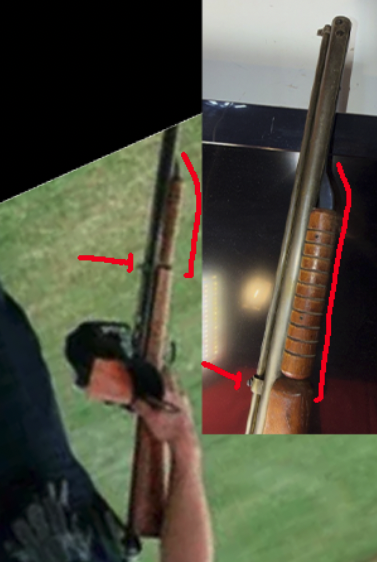
Petty’s rifle (bottom) A Benjamin Franklin model 312 (top)
Source: An eBay listing and the Rocky Mountain News.
(4) Petty claimed he didn’t have any ammunition with him. Police didn’t find any ammunition, including pellets, or BBs. Approaching a mass shooting scene with an air rifle is crazy enough. Why would someone arm themselves with an unloaded air rifle to “help” police take down an active shooter? It doesn’t make sense. Investigators never released any information regarding Petty’s vehicle. Did they search it? We don’t know.
(5) Petty had a criminal history consisting of multiple arrests for petty larceny, criminal trespass, and false reporting. With a criminal record like that, he should have known it was a bad idea to approach an active shooting scene at a high school armed with a rifle and a giant knife strapped to his leg.
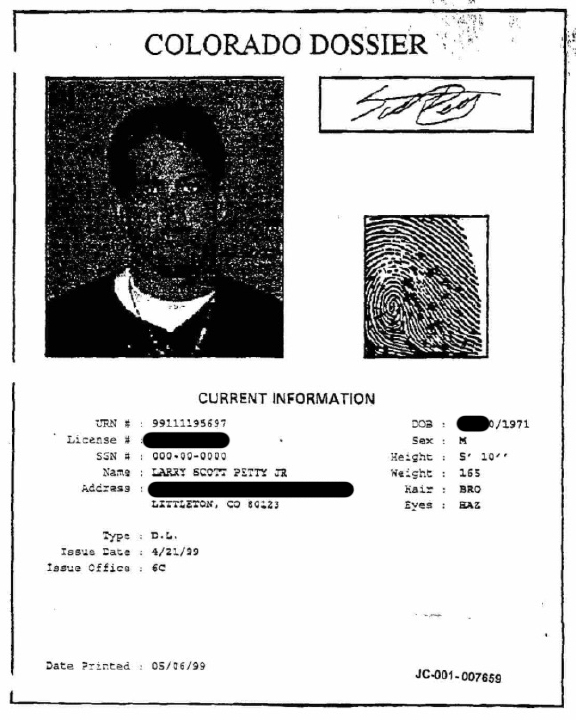
Petty’s mugshot.
Source: 11k, p.7659.
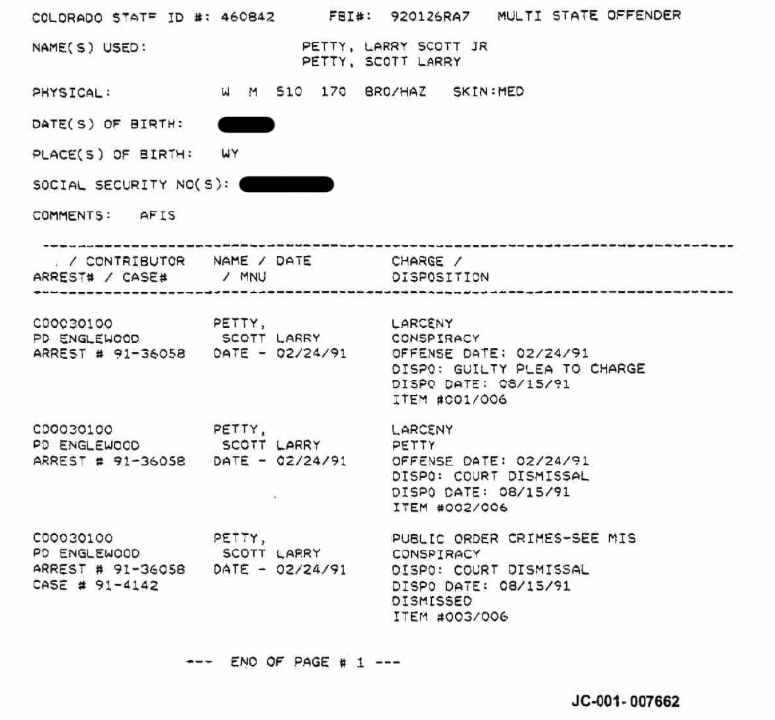
Petty’s arrest record.
Source: 11k, p.7662.
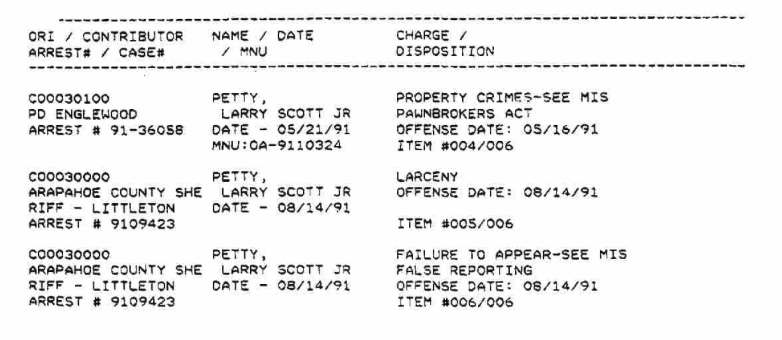
Petty’s arrest record.
Source: 11k, p.7663.
Interestingly, Petty’s contradictory stories seem to follow the same script as the contradictory stories told by the Splatterpunks. Both claimed they heard about the shooting on the news before it was broadcast, lied about having friends at the school, and said they came to the school to “help.”
Did Gardner shoot Petty?
The mushroomed bullet suggests Gardner shot someone in front of the West doors (or somewhere else if the bullet was actually found elsewhere). Whoever got hit by Gardner’s bullet would have been seriously wounded. But just because Gardner said he thought he shot someone doesn’t mean he shot the rifleman. He could have shot anyone, and in fact, that’s going to be addressed later in this dossier.
Larry Scott Petty—the man apprehended with the rifle on the West side—doesn’t appear injured in the photo capturing his arrest. It’s unlikely that he would have been able to hide a through-and-through shoulder wound from a .45 hollow point.
The evidence for Petty being the rifleman is fairly strong, but the bigger question is…
Who did Gardner shoot?
Nobody ever came forward about being shot by Gardner. So, what happened to the person he shot?
Did he shoot an additional suspect who got away?
Did he accidentally shoot an innocent student?
Or did he shoot someone whose identity had to be covered up to prevent exposing a much bigger problem with the official account?
Scott #2: JCSO Deputy Scott Taborsky
There was another man named Scott who was located on the West side of the school during the attack: Jefferson County Sheriff’s Deputy Scott Taborsky. Could Gardner have mistaken Taborsky as a suspect and accidentally shot him? While unlikely, this potential needs to be explored.
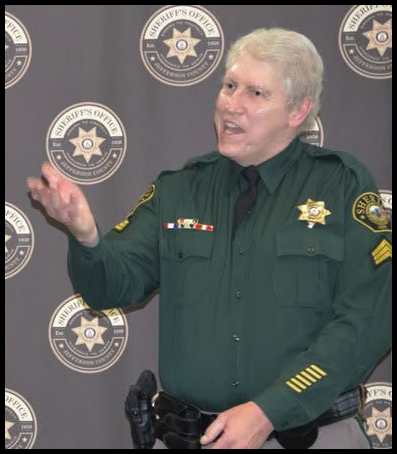
Jefferson County Deputy Scott Taborsky.
Source: Jefferson County.
At about 11:28 a.m., Taborsky (#144) can be heard on Channel 1 Tape 1 announcing to the dispatcher that he’s going to set up on the west back side of the school, and then at 11:30 a.m., he announces that he’s with MC2 (Deputy Paul Smoker) by the ballfields. Later, at around 11:42 a.m., he says he spots an unarmed individual matching the general description of Petty walking toward the school and Taborsky can be heard saying someone needs to make contact with him so they can maintain their perimeter.
It’s unlikely that Taborsky saw Petty since he and Smoker were located near the school’s ballfields and not the ballfields in Clement Park where Petty was arrested.
While Taborsky is heard reporting large caliber gunshots to dispatch at 11:30 a.m., radio traffic was describing a person in the library wearing a white t-shirt and some kind of holster vest, which sounds like Harris, and that was happening while Gardner was still reportedly under fire at the West doors.
There are some discrepancies regarding Taborsky
According to the official story, Taborsky arrived at the school with motorcycle unit Paul Smoker. However, official search warrants introduce Deputy Eric Miller as responding with Taborsky. According to the search warrants, Miller and Taborsky were dispatched to Columbine together. When they arrived, they saw students running from the school, heard gunshots coming from inside, and were told people had been shot. Even stranger, despite the official narrative that the rifleman shot at Taborsky, Taborsky reportedly never returned fire.
And despite being a critical first responder, there is no statement available from Miller. However, on page 10,036 in the 11k report there’s an E. Miller documented as being with Annette Walker and Paul Smoker when they detained the Splatterpunks.
Confirmation of Miller’s presence at Columbine:
“On April 20, 1999, at about 11:15 a.m., Jefferson County Sheriff's office dispatch received a call stating that there was a bomb in the area of Ken Caryl and Chatfield, County of Jefferson, State of Colorado. At the same time dispatch received another call reporting that a girl was "down" in the parking lot at Columbine high school. Deputy Paul Magor was dispatched at 11:1x a.m. to the bomb, and deputies Scott Taborsky and Eric Miller were dispatched to Columbine.
Upon their arrival, deputies Taborsky and Miller observed numerous students who were yelling and screaming as they ran out of the school. Deputies Taborsky and Miller were told by numerous students that people had been shot inside the school.”
Source: Search warrants, p.25,724.
While there are several discrepancies regarding Taborsky that need to be reconciled, it doesn’t seem like he could have been the rifleman at the west doors.
There’s one more Scott we need to look at.
Scott #3: Scott Fuselier
The third Scott connected to Columbine that needs to be examined is Scott Fuselier, a former Columbine student, Trench Coat Mafia member, and son of FBI agent Dwayne Fuselier, who led the entire Columbine investigation.
Scott Fuselier graduated from Columbine in 1997, two years before the massacre. That spring he helped produce and acted in a 9.5-minute homemade film titled Kaos with a K depicting a fictional attack on Columbine.
Students who worked on the film said it was a spoof of an upcoming spring play at the school called Get Smart, and the plot was about a secret agent battling a mad scientist trying to blow up the school.
The film featured gunfire, explosions, and students wearing trench coats “vaporizing” other students. The film ended with a remake of a scene from Independence Day where Columbine High School was blown up by a laser beam coming down from the sky.
This video has never been made public in full but Inside Edition obtained a copy and ran a short segment about it on May 5, 1999.
This video attracted media attention because it appeared to mimic the real attack with trench coated students roaming the halls and shooting a fake gun that resembled a TEC-9.
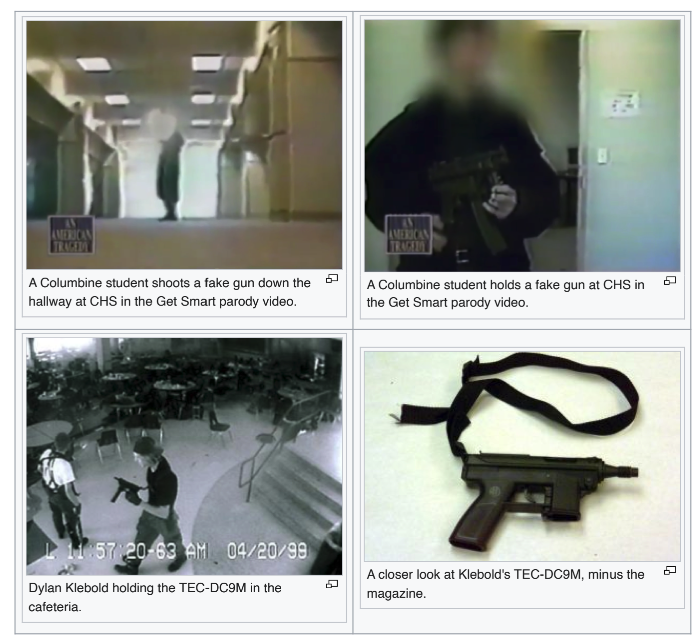
Source: Inside Edition and Jefferson County.
There’s also a scene where someone is working on a device that looks like a bomb.
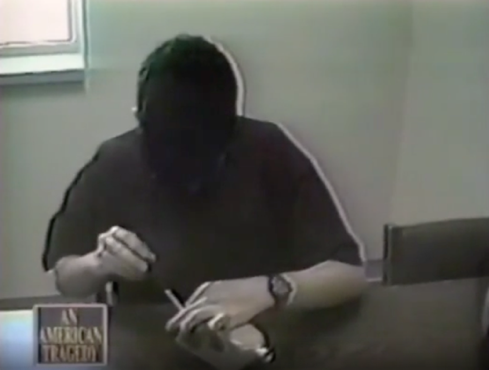
Source: Inside Edition.
The film depicts students using guns and bombs to resolve minor problems like having a pen stolen and being cut off in traffic. It seems like a joke, and that’s exactly how the film’s creators described it. However, some of the people who made the film were part of the Trench Coat Mafia, whose members were running around the local area detonating real bombs.
What many people overlooked is that the scene showing a person being shot outside was filmed in the exact area outside the west entrance where Rachel Scott and Richard Castaldo were gunned down. The individual who was “shot” in the video was sitting exactly where Scott and Castaldo were sitting. The film also featured a shootout in the parking lot near the library with the library windows in full view.
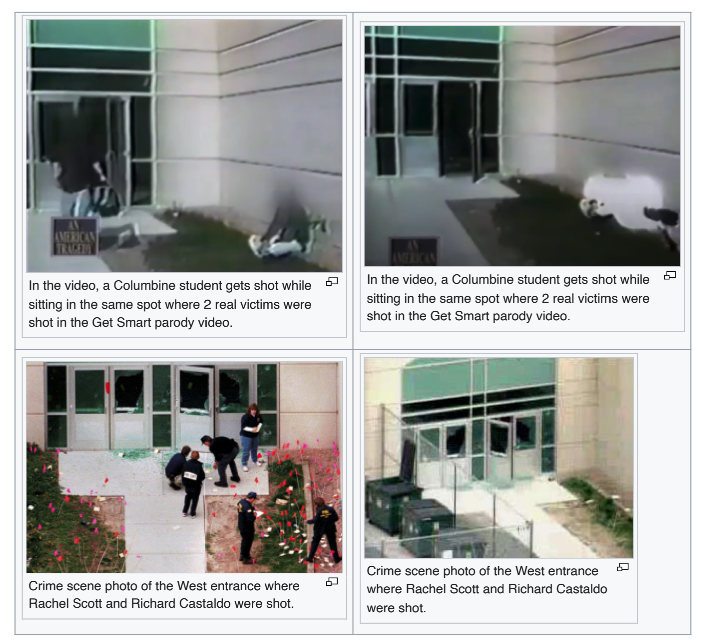
Source: Inside Edition and Jefferson County.
The Denver Post described the plot as follows:
"One character, the 'bad guy,' is intent on vaporizing Columbine by shooting a beam from a satellite hovering high over Colorado. Another character, a 'good guy' who wears a trench coat, is intent on stopping the bad guy from vaporizing the school. The third character is a fellow who mistakenly thinks the 'good guy' stole his pen. The fourth character is a fellow who believes that he was cut off in traffic by the one who 'lost' his pen.
During the video, the trenchcoated 'good guy' fires a gun at the 'bad guy' as the bad guy runs out of the school.
During the next few minutes, the characters shoot weapons at one another at various locations away from the school, never hitting each other.
They finally end up in a standoff. At that point they decide to set aside their differences. However, they don't stop the plot to vaporize the school.
The final scene shows the four walking away from the school. As they do, a beam comes out of the sky and Columbine is vaporized."
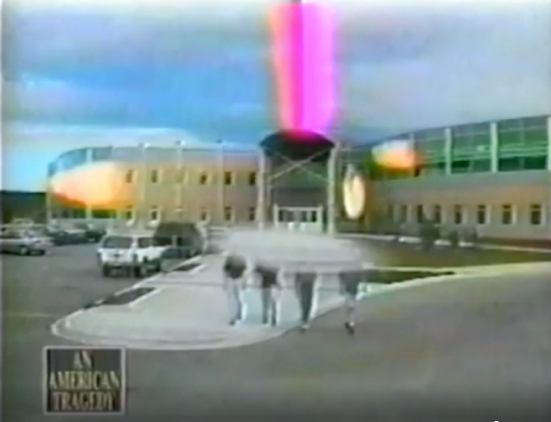
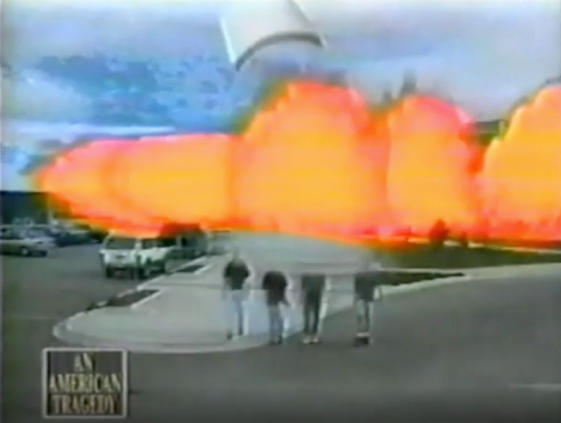
Source: Inside Edition.
When contacted by the Associated Press, Scott’s father, Dwayne Fuselier, declined to comment on the video.
Scott Fuselier hasn’t been officially connected to Harris and Klebold
Investigators never established a connection between Scott’s film and Harris and Klebold, who would have been sophomores at the time, and this video isn’t evidence that Scott participated in the massacre. However, given that so many Trench Coat Mafia members seem to have been involved in making and detonating bombs, threatening to blow up the school, and some even seem to have been accomplices that day who got away (this will be covered in a future dossier), it’s hard to dismiss the possibility that Scott may have been the rifleman.
Where was Scott during the shooting? Brooks Brown told investigators that Scott was in California where he was attending college for film school. But officially, we don’t know. There are no publicly available interviews with Scott.
Brown is the only source for Scott Fuselier’s whereabouts on April 20, 1999, but without documentation, it’s hard to believe. He told a litany of lies throughout the investigation. He also lied about being involved with Scott’s film.
When Inside Edition came to knocking on Brown’s door asking if he helped make the video, Brown said he didn’t have anything to do with it. But then he quickly changed his story and said he did help a bit with the editing. In his book, No Easy Answers, Brown admitted to lying to Inside Edition and said he never worked on the film.
Gardner may not have known Scott Fuselier
Gardner became Columbine’s School Resource Officer toward the end of 1997, halfway through the 1997-1998 school year. Scott Fuselier graduated during the spring of 1997 during the 1996-1997 school year. Unless Gardner was in his role as a softball coach prior to his employment as the School Resource Officer, Gardner couldn’t have met Scott Fusellier at Columbine. If Fuselier was the rifleman, which doesn’t seem to be the case, Gardner wouldn’t likely have known who he was unless someone else told him.
Does Scott Fuselier match the description of the rifleman?
Scott’s senior photo shows him with dark hair, which doesn’t match the rifleman’s description of having light colored hair. However, that doesn’t mean much since hair can be bleached and colored. He does appear to have a thin build.
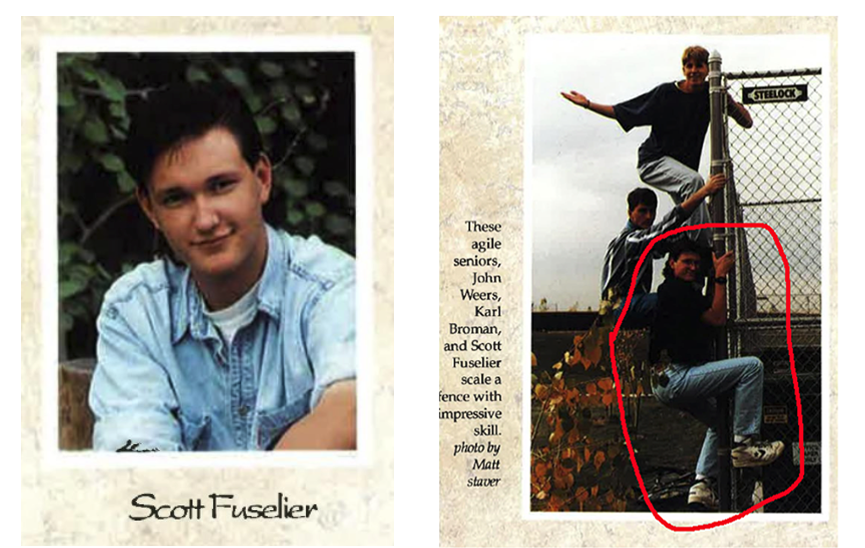
Scott Fuselier, senior photo, 1997 (left). Scott Fuselier climbing a fence (right).
Source: CHS yearbook, Rebelations, 1996-1997.
Scott Fuselier.
Source: CHS yearbook, Rebelations, 1996-1997.
The evidence doesn’t establish that Scott Fuselier was the rifleman but it presents a question worth pursuing. Gardner’s reference to “Scott” may have been a mistake, but Scott’s age, his connection to Columbine and the Trench Coat Mafia, and the scenes depicted in his film make him a person who should have been interviewed and whose whereabouts should have been documented.
The conflict of interest with Dwayne Fuselier, FBI lead investigator
Dwayne Fuselier.
Source: Unknown.
Dwayne Fuselier, Scott’s father, was an FBI psychologist and the lead investigator assigned to Columbine. He’s also the psychologist who came up with the idea that Harris was a psychopath and Klebold was a “depressive.”
Dwayne’s son created a film depicting an attack on the school by trench-coated gunmen, a scene that mimicked a real murder scene, and the destruction of Columbine. This should have been a good reason for Dwayne to recuse himself of his position. Instead, the potential conflict of interest was brushed aside.
From a Rocky Mountain News article:
“A News editorial, noting the link to Brown, criticized the FBI and Fuselier for refusing to talk about the issue and for downplaying a potential conflict of interest. Though they didn't say it publicly at the time, Fuselier and other officials now acknowledge they discussed it.
Fuselier offered to quit the case if the tape compromised his role.
Forget it, Kiekbusch said. If everyone with a link to Columbine quit the task force, there'd be no one left.”
"FBI spokesman Gary Gomez said there was ‘absolutely no discussion’ of reassigning Fuselier, 51, a psychologist, in the wake of the disclosures in Friday's Denver Rocky Mountain News. ‘There is no conflict of interest,’ Gomez said."
Source: Rocky Mountain News, May 8, 1999.
Excerpts from the official record:
(1) Harris is officially declared the suspect involved in the shootout
“As Gardner steps out of his patrol car, Eric Harris turns his attention from shooting into the west doors of the high school to the student parking lot and to the deputy.
Gardner, particularly visible in the bright yellow shirt of the community resource officer’s uniform, is the target of Harris’ bullets. Harris fires about 10 shots at the deputy with his rifle before his weapon jams.
Gardner, seeing Harris working with his gun, leaned over the top of the car and fired four shots. He was 60 yards from the gunman. Harris spun hard to the right and Gardner momentarily thought he had hit him. Seconds later, Harris began shooting again at the deputy.
Although Gardner’s patrol car is not hit by bullets, two vehicles that he is parked behind are hit by Harris’ gunfire. Investigators later found two bullet holes in each of the cars.
Harris then turns and enters the school through the west doors.”
Source: Official report released by the Jefferson County Sheriff’s Office.
(2) Gardner describes the suspect
Detective Boatright: “…describe this person to me.”
Neil Gardner: “White male… Dark baseball cap on backwards... flack [sic] jacket and a white [T-shirt] … I can’t tell you what kind of pants they were wearing other than they were dark… Light colored hair, um, it wasn’t too long, I guess it was about to here.”
Detective Boatright: “Are you saying collar length hair?”
Neil Gardner: “Yeah.”
Detective Boatright: “About how tall was this person?”
Neil Gardner: “Five-ten, six foot. He was pretty tall.”
Detective Boatright: “Okay, uh, weight?”
Neil Gardner: “Skinny.”
Detective Boatright: “Do you recognize this person you’ve shot at?”
Neil Gardner: “No.”
Detective Boatright: “Do you know who he is?”
Neil Gardner: “No.”
Detective Boatright: “Okay. Do you believe that he was a student there? I mean, are you saying, do you know everybody that goes to school there?”
Neil Gardner: “I have no idea who he was. Other than he was a, a young adult… I don’t know if he’s a student or, or what.”
Detective Boatright: “Okay. You didn’t get a good enough look at him to identify him.”
Neil Gardner: “No.”
Detective Boatright: “…you estimate him to be what age.”
Neil Gardner: “Late teens, early twenties.”
Neil Gardner: “Right, I never did see a second suspect.”
Source: Neil Gardner’s interview transcript, pp.11158-11251.
(3) Gardner refers to the suspect as “Scott” and then switches to “Harris”
Neil Gardner: “Eric Harris, yeah, because I had the two deans with me, I could recognize Klebold but I couldn’t recognize Scott so the two deans were with me.”
Detective Boatright: “Right you say you can recognize Dylan but…”
Neil Gardner: “But not Eric Harris.”
Source: Neil Gardner’s interview transcript, pp.11158-11251.
(4) Larry Scott Petty, Jr. was apprehended with a rifle nearby
“Sgt. McNitt said that he was on duty and responded to the scene of the Columbine shooting to assist and was establishing a perimeter near the Jefferson County Library, Columbine Branch, when he observed Petty running toward the high school with a rifle in his hands.
Petty was contacted and taken into custody by Agent McNitt. McNitt said that he took custody of the rifle and a knife, which Petty had strapped to his leg.”
“Petty is a white male, 5’10”, 165 lbs., with brown hair and hazel eyes. Petty is further identified by NCIC/CCIC arrest record, Colorado SID 460842, Georgia SID 1975667P, and FBI #920126RA7. Petty’s criminal history involves petty larceny, criminal trespass, and false reporting.”
Source: 11k, pp.9067-9075.
(5) An officer heard and saw gunfire coming from a bush on the West side not too long before observing Petty taken into custody
“Deputy Brovsky arrived at 1135 hrs and set-up [sic] position on the SW corner of Clement Park behind an R-1 security Jeep. Dep. Brovsky heard and observed gunfire coming from behind a bush on the West side of the school.”
“Dep. Brovsky re-located [sic] her position near the soccer fields when she encountered (W) McNitt taking (S) Petty into custody. (S) Petty was armed with a 22 cal short bolt action rifle and a 6 ½ survival knife. (S) Petty was wearing a black T-shirt and ball cap with a Navy Seals logo and black combat boots and blue jeans. Deputy Brovsky advised (S) Petty was given a GSR test, interview, + released at about 1530 hrs.”
Source: 11k, pp.35117-25118.
(6) Larry Scott Petty, Jr. tells investigators his rifle was just a BB/pellet gun
“Petty explained that the rifle was an air pump .22 caliber BB/pellet gun and that he did not have any ammunition with him at the high school.”
Source: 11k, pp.9067-9075.
(7) Larry Scott Petty, Jr. tells contradictory stories to explain his presence
“Petty told Det. Hayes and Inv. Vette that he was just getting out of the shower preparing to go to work on 04-20-99 when he saw a news bulletin concerning Columbine High School on television between 11:20 and 11:30 A.M. Petty said that he wanted to help at the school so he quickly took his air rifle and knife and drove his white Toyota Tacoma pickup truck to the pavilion at the Jefferson County Library parking lot where he parked and attempted to approach the school.”
“Petty said that he does not currently know any students or faculty at Columbine High School, however, he did have some friends that attended the school during the early 1990s.”
“Petty said that his only purpose for going to the school was to attempt to help the responding police agencies and the students inside the school.”
Source: 11k, pp.9067-9075.
Petty told Agent Brovsky a different story
“(S) Petty said he got a phone call at home about 1130 from a Columbine student who told him someone was shooing kids and to come and stop them.”
Source: 11k, p.9773.
(8) Gardner describes hitting the suspect in the right shoulder
Neil Gardner: “I don't know if it was close it scared him. If it hit his flack [sic] jacket or, or what.”
Detective Boatright: “And he spins, which direction does he spin?”
Neil Gardner: “He spins, he spins this way and he comes back. And then he starts his...”
Detective Boatright: “And this is when you think you possibly hit him with that first round.”
Neil Gardner: “Right, yeah. It either hit him or it, it came real close.”
Detective Boatright: “Could you tell where, if you hit him. where you hit him?”
Neil Gardner: “It would of, the way he spun or whatever…”
Detective Boatright: “You're thinking maybe in his right shoulder?”
Neil Gardner: “Yeah, cause I was. It didn't get a real good beat on center mass but maybe the right upper.”
Source: Neil Gardner’s interview transcript, pp.11158-11251.
(9) Gardner identifies Klebold and pretends he doesn’t know Harris
Neil Gardner: “Now they’re telling me who it is, it’s the two suspects and now I know who they are.”
Detective Boatright: “You know them by name.”
Neil Gardner: “Yeah.”
Detective Boatright: “Okay, who are they, who were you told were the suspects.”
Neil Gardner: “Uh, Dylan Klebold and, ah, Jesus, I’m drawing a blank now, God, I don’t know this kid as well but we had two deans that did and I’m sorry I can’t remember his name.”
Detective Boatright: “If I said his name would you recognize it.”
Neil Gardner: “Yeah.”
Detective Boatright: “Eric.”
Neil Gardner: “Yeah.”
Detective Boatright: “Harris.”
Neil Gardner: “I believed him to be Dylan… cause Dylan’s a lot taller than Eric Harris… just based on the stature of Dylan compared to Eric is a shorter person.”
Detective Boatright: “But you wouldn’t know Eric Harris, correct.”
Neil Gardner: “Uh uh. I didn’t know till I saw a picture of him.”
Detective Boatright: “Okay. Did you recognize him from the photo then.”
Neil Gardner: “No.”
Detective Boatright: “Okay so you really don’t know this kid at all.”
Neil Gardner: “I had never dealt with Eric Harris.”
Source: Neil Gardner’s interview transcript, pp.11158-11251.
Gardner Case Anomaly #5:
Gardner Told Different Stories with Details That
Don’t Match the Documented Evidence
In an April 26, 1999 interview with Sarah James from NBC—just six days after the massacre—Gardner told an interesting story about his first exchange with the rifleman.
Deputy Neil Gardner.
Source: NBC.
James: “Did he see you, Neil? Was he shooting directly at you?”
Gardner: “Yes, yes he was. Because we could, we could hear the bullets fly over and we could hear ‘em go underneath the Blazer.”
James: “How close did they get?”
Gardner: “A couple hit the front windshield, one hit, um, the passenger rearview mirror, and the glass was falling down onto my shoulders.”
There are some problems with this particular story.
If any of the rifleman’s bullets went under the Blazer, I haven’t been able to locate them in the evidence logs or on the evidence maps.
When Gardner referred to a “passenger side rearview mirror” it seems he meant “side mirror.” However, investigators didn’t document any damage to either of the Blazer’s external mirrors.
The official narrative, along with Gardner’s own words, only place him on the driver’s side of the Blazer.
In his initial interview the same day of the shooting, Gardner never mentioned a mirror being shot out or glass shattering over his shoulders. That would be a major detail to omit.
Gardner Case Anomaly #6:
Gardner Denied Knowing Harris and Klebold Were Making
and Detonating Pipe Bombs; He Later Told the Truth
Within weeks of the shooting, word got out that Gardner was keeping an eye on Harris and Klebold after they were reported to police for making and detonating bombs in 1997. Gardner initially denied knowing anything about their bomb-making activity, and denied knowing them at all.
Gardner eventually admitted he not only knew Harris and Klebold, but he knew they were making bombs and was tasked with monitoring Harris and Klebold at school.
April 26: Gardner admits to knowing both Harris and Klebold
In an April 26, 1999 interview with Sarah James from NBC—just six days after the massacre—Gardner admitted he knew both Harris and Klebold.
James: “Were those names you knew?” [Eric Harris and Dylan Klebold]
Gardner: “Mmhm, yeah, as part of, they called themselves the Trenchcoat, uh, Mafia.”
April 26: Gardner denies knowing Harris and
Klebold had the potential for violence
In another April 26,1999 interview with Deborah Roberts for 20/20 Monday, the reporter/narrator stated, “Gardner couldn’t believe that Eric Harris and Dylan Klebold, two students he knew and never had much trouble with, were doing the shooting.”
Roberts: “Is it surprising to you that they could have carried out something this detailed and this violent?”
Gardner: “Absolutely. I had no indication that they would ever be this violent. They were never disrespectful to me, and uh, I never had a problem with them.”
In the same interview, Gardner explicitly denies being
informed of Harris and Klebold’s bomb-making activities
Reporter: “There are reports surfacing now that neighbors of the Harris’ [the Browns], uh, claim that they had actually warned the Sheriff’s department and had complained about, uh, Eric Harris’ violent behavior, about his website, and that no one listened to them. Are you aware of this?”
Gardner: “Okay, um, no, I’m really not. I’ve been told that investigations may have done a search warrant, um, on Eric Harris last year and nothing was found to the information that he may be building pipe bombs, but I, to my knowledge I believe they didn’t find anything. I was never alerted to that fact.”
Gardner finally admits he knew about
Harris and Klebold’s bomb-making activities
In an April 26, 1999 interview for ABC news, Randy and Judy Brown discuss reporting Harris to the Sheriff’s department. The narrator states, “Some of the information given to the Sheriff made its way to Neil Gardner a Deputy who was assigned to the high school.”
Reporter: “Had you been told about that, I mean, did you have any kind of warning about him?”
Gardner: “Uh, a little bit, yeah, that he might be capable of making some bombs.”
School officials reported that Gardner had been
monitoring Harris and Klebold for over a year
“Davis [Steve] said the deputy stationed at the high school, Neil Gardner, was informed of the Browns' complaint and “occasionally engaged Harris and Klebold along with several of their friends and associates in light conversation. Deputy Gardner… stated that both Harris and Klebold treated him with appropriate respect.” Gardner also told one of the high school deans he was monitoring Harris and his friends because of the reported threats, said Lt. John Kiekbusch, the lead investigator on the case.”
“Gardner, who exchanged gunfire with Harris and Klebold last week, did advise the deans a year ago that Harris "was possibly messing around with pipe bombs and explosives,” according to Rick Kaufman, a spokesman for Jefferson County schools.”
Source: The Denver Post, May 1, 1999.
Gardner Case Anomaly #7:
Gardner’s 8 Shell Casings Were Found In the Wrong
Location for Shots Fired Over the Blazer’s Hood
On the evidence maps, a group of eight shell casings attributed to Deputy Neil Gardner appears in the parking lot behind the white Blazer. The casings are identified as JCSO evidence #2720/CBI #228 and are described as “8-45 Auto brass.”

Gardner’s 8 shells logged into evidence.
Source: CBI lab report, p.1608.
These eight casings present a serious problem for Gardner’s account of where he was standing when he fired. Gardner was armed with a SIG Sauer P220 semiautomatic .45 pistol. He originally claimed that during his first confrontation with the rifleman at the West entrance, he took cover by the left front of the Blazer behind the engine block and fired eight rounds in two separate volleys of four shots over the hood toward the suspect.
Gardner: “At that time, I got as small as I could get behind the back tire of the Chevy Blazer. And about, about ten-to-fifteen volleys of bullets, you could hear ‘em going over the car. So then I moved to the front of the car behind the engine block, and I shot four-to-five times at, at the suspect.”
Source: Interview with ABC News, days after the shooting.
If Gardner shot at the rifleman over the hood of the Blazer, his shell casings should be located toward the front of the Blazer.
The direction Gardner’s gun ejected casings
doesn’t match their location on the evidence map
The P220 ejects spent brass to the shooter’s right. If Gardner were behind the front left side of the Blazer while firing across the hood, his casings should have been distributed somewhere around that firing position. They could have struck the vehicle or the windshield, or landed near the front on either side of the Blazer. They wouldn’t have landed as a single group in the parking lot behind the Blazer. Yet that’s exactly where all eight of Gardner’s recovered shells were plotted on the evidence map.
If Gardner’s eight shells were actually found where they’re plotted on the evidence map, he would have fired all eight shots from roughly the same position toward the back of the Blazer.
How did eight shell casings produced during separate volleys, fired in different directions, end up grouped together in one location behind the Blazer?
Either Gardner fired all of his rounds from the rear of the Blazer, or the evidence map doesn’t accurately represent the location of his casings.
If Gardner lied about his firing position, why would he do that? What would it matter if he fired from the front or back of the Blazer?
Maybe he didn’t fire any shots from the parking lot after all.
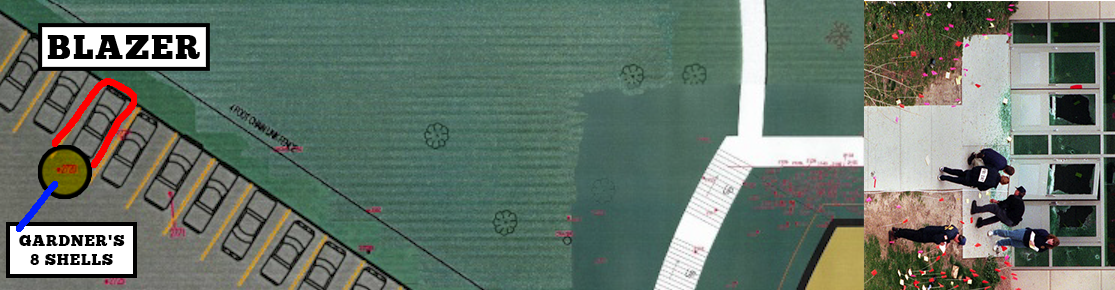
Left: Evidence map showing where Gardner’s 8 shells were recovered behind the Blazer; JCSO #2720.
Right: crime scene photo of the West entrance to demonstrate location and orientation; not to scale.
Source: Jefferson County.
The official maps contradict Gardner’s story
of firing over the Blazer’s hood
Although the following image is from nearly two hours after the alleged shootout at approximately 1:12 p.m., it shows Gardner in his bright yellow shirt standing exactly where he claims to have been when he shot eight times at the rifleman over the hood of the Blazer.
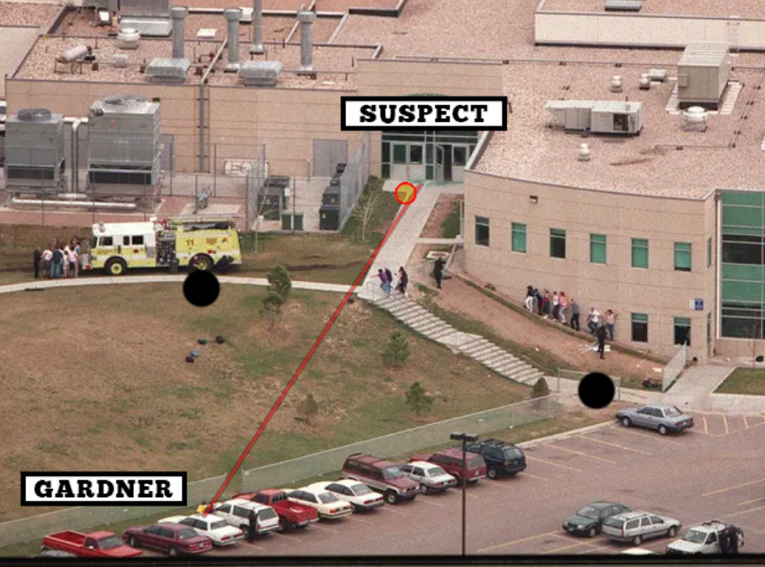
This is not a scene from the shootout.
Source: Unknown.
Despite Gardner insisting that he fired from behind the engine block over the hood of the Blazer, Jefferson County released a diagram showing Gardner firing from behind the Blazer. Did they release this altered diagram to match the location of his shells?
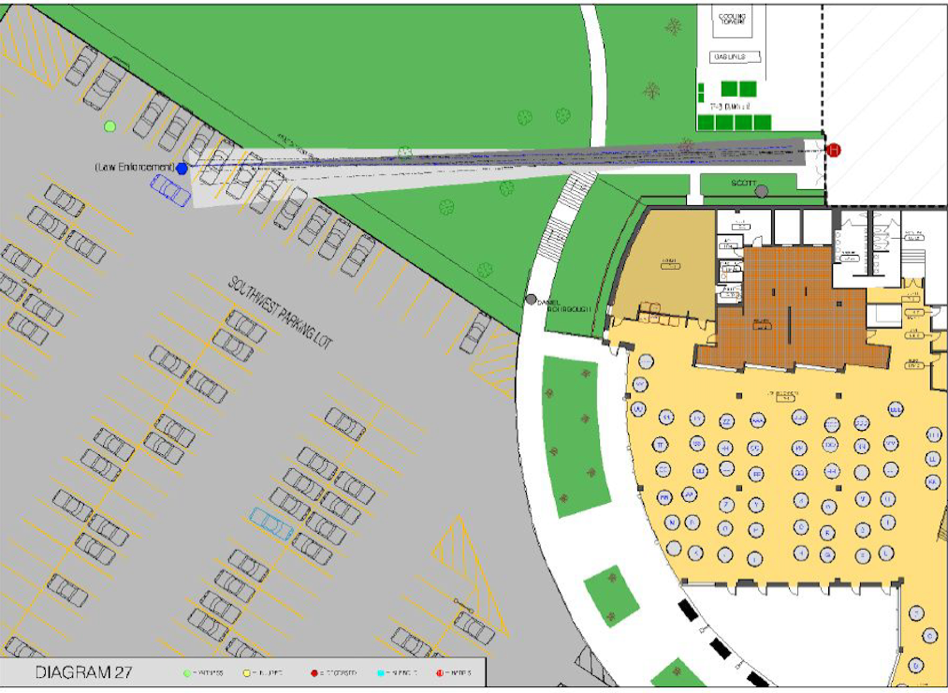
This diagram depicts Gardner’s patrol vehicle in blue parked behind the
Blazer while Gardner fires at the rifleman from behind the Blazer.
Source: Jefferson County.
Did Gardner lie about shooting over the hood of the Blazer? If so, why? Or was his account of firing over the hood correct, and investigators fabricated the map and location of his shells? Both the evidence map and Gardner’s story can’t be true.
Gardner Case Anomaly #8:
Gardner Denied Shooting Into the Library But Two Of His Bullets
Were Found In the Library; One Was Lodged In the Wall
At first, Gardner claimed to have fired all eight shots at the West doors while standing in the parking lot. After the first shootout where he fired his first “four or five” shots, Gardner describes shooting another volley of four shots at the rifleman in the same location:
Gardner: “I raise over the hood and I shoot four more times towards the door. I shot a total of eight shots.”
Boatright: “Now these other four shots, do you know where they went?”
Gardner: “Towards the door.”
Gardner also explicitly denied firing into the library while explaining that it was other officers who fired into the library while he watched.
Gardner: “And the next time I see the suspect which is, I mean we’re talking just a few minutes later after this last volley, you can see him in his flak jacket up in the library and that’s when the DPD officers and I don’t know who else, I didn’t shoot anymore, they started shooting at the upper window.”
Source: Neil Gardner’s interview on April 20, 1999.
Two of Gardner’s bullets landed in the library
Three pieces of ballistic evidence recovered from the library were traced to Gardner’s gun:
CBI #315/JCSO #940: “Live .45 round”
CBI #428/JCSO #746: “Bullet in wall”
CBI #508/JCO #998: “Bullet fragment”
Source: Evidence Vol. II, p.12063, 12068, 12072.
This suggests that Gardner fired into the library at least once. The fragment may have been a second bullet. We’ll discuss the live round in a minute.
If Gardner only fired at the rifleman in front of the west doors, how did one of his bullets land in the library wall? The west doors and the library aren’t close enough for it to have been a mistake.
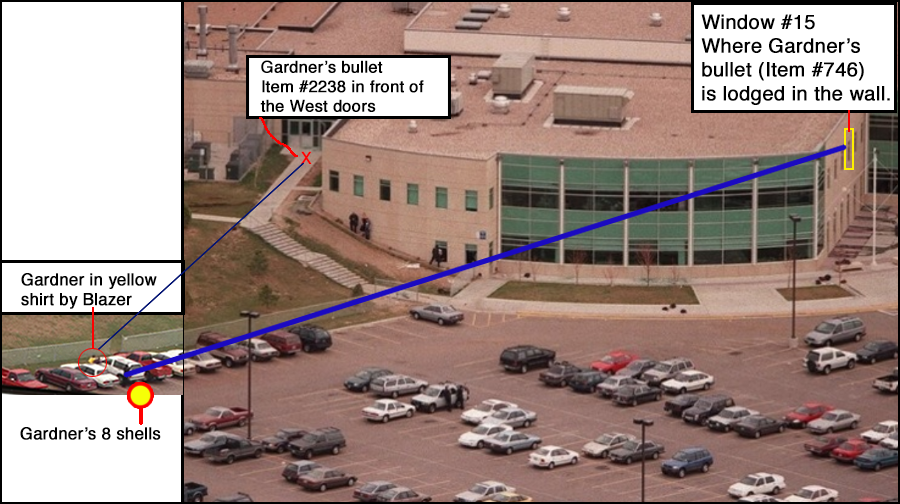
The approximate trajectory from the Blazer to window #15
if Gardner fired into the library from the parking lot.
Source: Channel 4 news helicopter footage.
Here’s a view of window #15 (W15) from the inside:
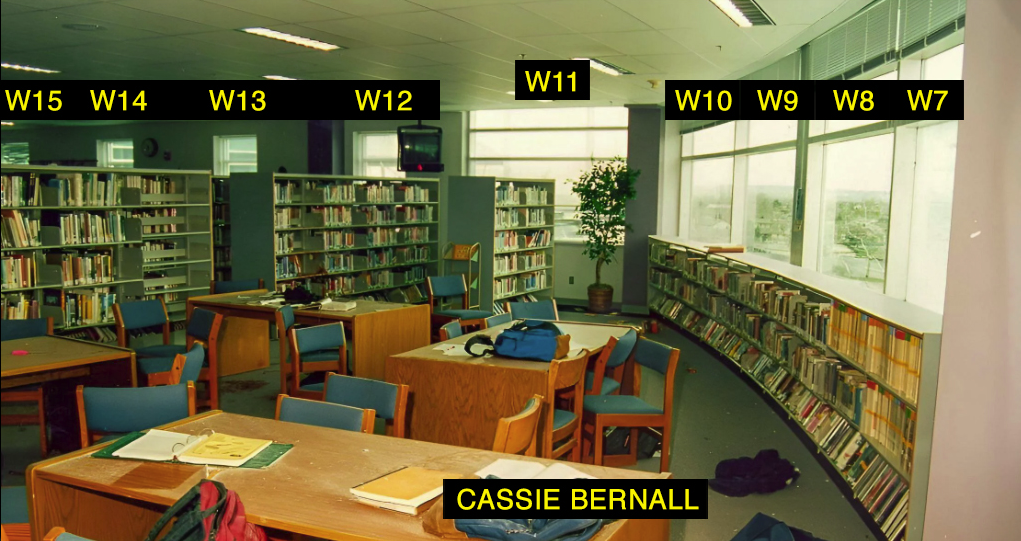
Library windows numbered.
Source: Jefferson County.
Based on the official story that Harris was shooting at Gardner and the other officers from the library, returning fire would have been justified. Other officers acknowledged they fired into the library. So why did Gardner initially lie and deny shooting into the library? Did he hit an innocent student?
Out of eight rounds Gardner allegedly fired, only two bullets were recovered and identified. At least, that’s what was released to the public. We have no idea where five to six of Gardner’s bullets landed. If the fragment in the library was actually a bullet (the description changed from ‘fragment’ to ‘bullet’ over time), then we’re missing five of Gardner’s bullets.
Gardner admitted to El Paso that he fired into the library
When interviewed by El Paso County during the investigation into the death of Daniel Rohrbough, Gardner finally admitted to firing into the library. He identified the other officers with him who fired into the library as Deputy Paul Smoker and a Denver SWAT officer.
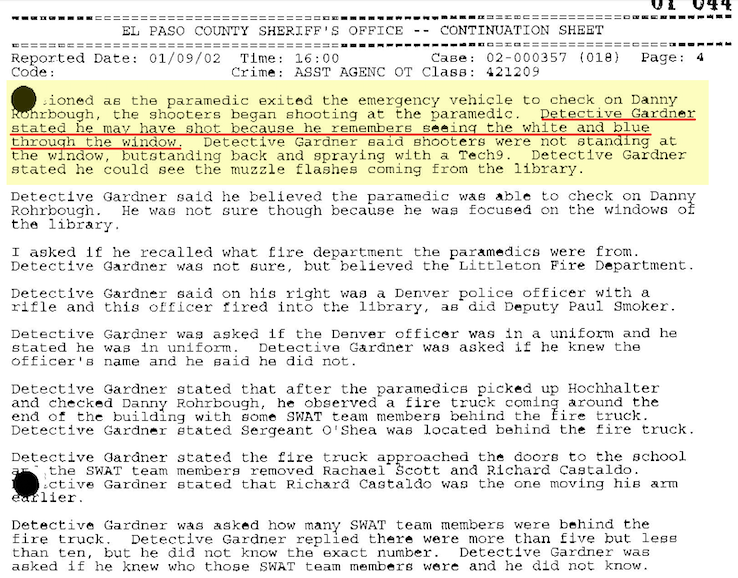
Source: El Paso, Case Core, p.44.
A first glance, it seems like Gardner may have lied about firing into the library to cover himself but there’s more to the story. Ballistic evidence places Gardner inside the library—something he has, to this day, never admitted.
Gardner Case Anomaly #9:
Ballistic Evidence Places Gardner Inside the Library
Early reports placed Gardner in the school during the incident
Reports that an officer, and specifically Gardner, pursued the suspects into the school were dismissed as a rumor. However, it was part of the original narrative that was later retracted and rewritten.
“Davis [Steve] said three deputies exchanged gunfire with the suspects, including deputy Neil Gardner, assigned as security at the school, who remained inside during the ordeal.”
Source: Police Remove 15 Bodies from Shooting Scene, Houston Chronicle, April 21, 1999.
“Jefferson County Sheriff’s Department spokesman Steve Davis said dispatch got its first call at 11:19 a.m… Within minutes, seven or eight officers were inside, Davis said, and three of them, including the resource officer [Gardner], exchanged gunfire with the suspects.”
Source: Officers defend response, The Denver Post, April 23, 1999.
Early reports—even quotes from officials—are obviously capable of containing mistakes. Alone, these statements don’t prove much. But when combined with the physical evidence and police radio traffic we’re about to get into, it’s hard to dismiss.
Although Gardner eventually acknowledged shooting into the library, he always maintained that he never entered the building. We already discussed how Lt. Potter’s statement and dispatch radio contradict this claim, but ballistic evidence also contradicts this claim.
Ballistic evidence places Gardner inside the library
A live round traced to Gardner’s gun was found on the library floor near Steven Curnow’s body.
CBI #315/JCSO #940 is documented as a “Live .45 round” and was traced to Gardner’s gun.
This .45 caliber live round traced to Gardner’s gun wasn’t a fired bullet that could have entered the library from outside. It was documented as a live round. This is significant.
A live round can’t be traced to a gun just because it came out of a magazine. For a firearm to leave identifying marks on a live cartridge, the round must first be chambered and then extracted and ejected without being fired. That’s exactly what happens when a chamber is cleared. The presence of this live round on the library floor suggests Gardner’s weapon was cleared inside the library.
This creates an obvious problem with the official account that states Gardner never entered the school.
There are only a handful of possibilities:
Gardner ejected the round while inside the library. Most likely
Someone else entered the library carrying Gardner’s loaded gun and cleared it there.
Gardner cleared his weapon somewhere else, and someone picked up that bullet and carried it into the library and dropped it next to Steven Curnow’s body.
The evidence identification itself is wrong.
If the original evidence documentation is accurate, the first explanation is the simplest: Gardner ejected the round while inside the library. But when, and why? And why was it covered up?
Investigators changed the description of
Gardner’s live round to a spent bullet
Strangely, CBI #315/JCSO #940 was originally documented as a “Live .45 round” during the investigation by the investigator who located and tagged the bullet. However, by the time it was submitted to the CBI lab for testing, it was changed it to “One fired 45 caliber bullet.”
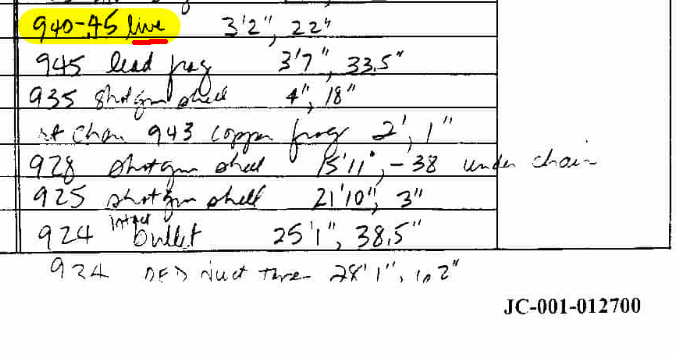
#940 initially documented as a live round.
Source: Library, Team Two, p.12700.
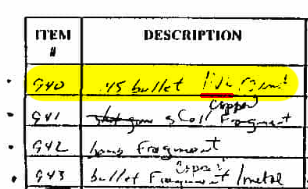
#940 entered into evidence as a live round.
Source: Library, Team Two, p.12681.
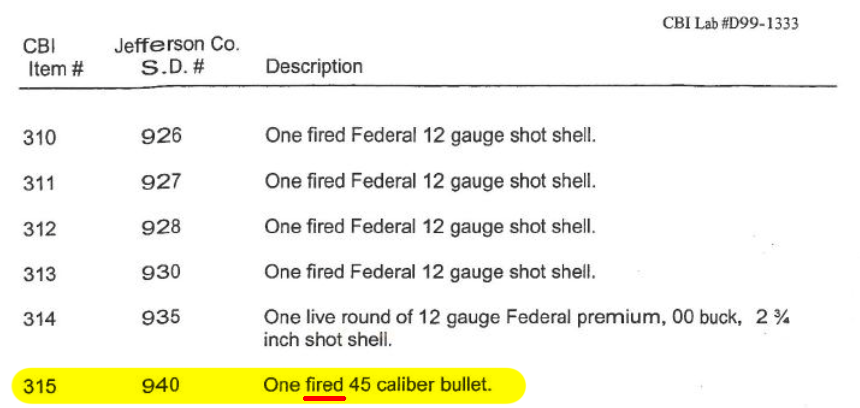
#940 later documented as a fired round.
Source: CBI Lab Report, p.2180.
This sudden change of description seems fishy. Investigators wouldn’t mistake a live round for a spent bullet. It appears to have been changed to support the official story that Gardner never entered the library. And that’s supported by the evidence.
Gardner was missing exactly one live round
When Gardner turned over his firearm, magazines, and ammunition, one of his magazines was exactly one round short. He handed over a 7-round capacity magazine loaded with just six bullets, claiming one came from the chamber. When asked what happened to the missing 7th cartridge, he said he didn’t know. This fits with the live round recovered from the library. This would have been the magazine inserted into his gun that he ejected before clearing the chamber.
If a bullet from this particular magazine really came from the chamber, it would have marks on it. There is no evidence that anyone verified Gardner’s claim by inspecting each round to see if one was ejected from the chamber.
From Gardner’s interview with Detective Russ Boatright:
Boatright: “Okay, and uh, let me take a quick look at your magazines that you’d, no leave the one in the gun but just the two that you’ve got there. Okay, so you have one empty…”
Gardner: “Um hmm. And I don’t know where that bullet is, that should be loaded, I didn’t even use that clip.”
Boatright: “And you’re the only one that’s handled your weapon, correct?”
Gardner: “Right.”
Source: Neil Gardner’s interview transcript, pp.11158-11251.
Gardner cleared his weapon while the scene was still active
When involved in a shooting incident, officers are only instructed to clear their weapons after the threat has been neutralized and police have full control of the area.
Was Gardner in the library when the scene was declared secure? That seems unlikely. SWAT didn’t make entry into the library until 3:30 p.m., and didn’t declare the building safe until 4:30 p.m. He was already at the command post by 2:00 p.m. (per Gardner) or 3:00 p.m. at the latest (per Marton), which is a half hour to an hour before SWAT entered the library.
Why would Gardner clear his weapon in the middle of a shooting incident before anyone has secured the building? What triggered him to engage the muscle memory of clearing his weapon as if the incident was over? Even if he saw Harris and Klebold dead on the floor, there were reports of other shooters, and nobody knew what was going on at that point.
At least, that’s the official narrative. Since I’ve been able to prove that nobody died that day, we have to look at Gardner clearing his weapon through a different lens.
What did Gardner find in that library?
Did Gardner chase what he believed to be real suspects into the library, only to be informed of the truth—that the whole thing was just a drill—causing him to clear his weapon and return to the parking lot where he pretended to take cover by the Blazer until they called him to the command post around 2:00-3:00 p.m.?
If Gardner knew the incident was a drill, his actions and reported location would likely line up with the official narrative and ballistic evidence, and Jefferson County wouldn’t have needed to cover up his actions or hide where they found most of his bullets.
Based on all the contradictions, it appears that Gardner had no idea the shooting was a drill, and he found out when he entered the library.
Did Gardner fire any shots from inside the library?
CBI #508/JCO #998 was originally documented as a “bullet fragment” but was later changed to “One fired copper jacketed bullet” when submitted to the CBI lab for testing. If this item was really a bullet, then two of Gardner’s fired bullets were recovered from the library. Did they come from the outside in, or were they fired from inside? And what about Gardner’s bullets that were never recovered? Where did those end up?
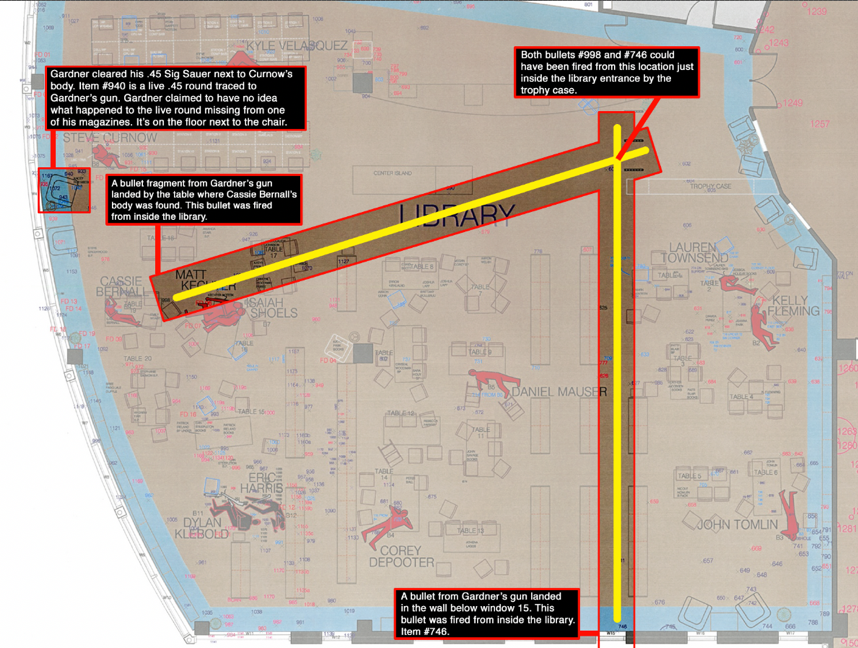
The library crime scene diagram showing Gardner’s potential firing position
if he chased the suspects into the library and fired from inside the library.
Source: Jefferson County & The Columbine Dossier.
Police radio traffic places Gardner inside the school
About 24 minutes after Gardner said he was in the back student lot at 11:32 a.m., after more than twenty minutes of radio silence from Gardner, the dispatcher and officer confirm Gardner is inside the school:
At the 27-minute, 7-second mark on the Channel 2 tape, the dispatcher communicates with Victor One (JCSO officer Sgt. Phil Hy, 11k, pp.8078-8079) regarding Gardner being inside the school. This appears to be approximately 11:56 a.m.
Dispatcher: “Is there any way to get to a victim on room three, second level of the high school? We have a victim that’s been shot in the jaw and they cannot control the bleeding.”
Officer: “I think 71 is the only one inside, we don’t have any inside secure [unintelligible] we can get.”
Dispatcher: “Okay, 71 is the only one inside the school at this time.”
Source: Channel 2 dispatch tape
Gardner does not radio back to confirm or deny his location in the school.
How did this officer know Gardner was in the school? A transmission from Gardner stating he’s entering the school isn’t on the dispatch tapes. The tapes have been cut in multiple places so if there was a transmission from Gardner, it’s been cut from the public release.
So, Gardner announced that he was in the senior lot at 11:32 a.m., went silent, and twenty minutes later he was confirmed to have entered the school. By 12:21, as Denver SWAT was ready to enter the school, an officer once again confirmed that Gardner was in the school, and another officer informed dispatch that Gardner had returned outside.
By 12:43 p.m., when SWAT loads Richard Castado into Taborsky’s patrol car, Gardner can be seen in the parking lot behind his cruiser and the white Blazer at various times. This is the first time Gardner is visible on the news footage.
Gardner may have been inside the school when the incident began
Two witnesses told the El Paso County Sheriff’s Department that they believed Gadner was already on scene before the shooting began.
“Only Jason Autenrieth and Keith Parkinson believed they saw a law enforcement officer on scene before the shooting started. Both Jayson Autenrieth and Keith Parkinson think the school resource officer, Deputy Neil Gardner, may have been on scene.”
Source: El Paso Report Summary, p.28.
That’s not all.
Lt. Dennis Potter from the Jefferson County Sheriff’s Department helped coordinate communications and logistics at the communications center during the shooting. He was communicating directly with dispatchers while monitoring radio traffic. According to Potter, Gardner was in the school hallway when the incident began.
From Channel 7 News Live (KMGH), April 20, 1999:
Reporter: “Is there any information on how they got so much stuff into the school? Was it a possibility that they stored this stuff ahead of time?
Lt. Dennis Potter: “No, no. We have a school resource officer [Gardner] at Columbine High School, and when this started he was right in the middle of the hallway, who was constantly aware of what’s going on in the school.”
Dennis Potter wasn’t just some random rookie they told to monitor radio traffic. By 1999, Potter had been working for the Jefferson County Sheriff’s Department for twenty-nine years. He retired as a Captain in 2004 after thirty-three years. During the incident, Jefferson County described his official role as “Headquarters Supervisor and Operations Chief.”
Deputy Dennis Potter
Source: Historically Jeffco, Volume 10, Issue 18, 1997
Taken in isolation, it’s easy to dismiss Potter’s report as an error. Potter may have been confused about Gardner’s location. But Potter was assigned to the Communications Center and coordinated communications and logistics with the county, cooperating agencies, and officers on site. He knew exactly where Gardner was. And Potter’s statement doesn’t exist in isolation.
There are multiple, independent pieces of evidence placing Gardner at Columbine before the shooting began and inside the school where he claims he wasn’t.
Potter placed Gardner in the hallway, two witnesses saw Gardner on scene before the incident started, police radio traffic placed Gardner in the school twice, a live round ejected from Gardner’s duty weapon was recovered inside the library, and when Gardner turned over his ammunition he was missing one live round he couldn’t account for. Yet Gardner maintained that he never entered the building.
The bigger issue isn’t whether Gardner was in the school. The important question is why the narrative says otherwise. If investigators had evidence placing an armed deputy inside Columbine while maintaining that he never entered, then the question of a cover-up isn’t unreasonable. It’s the most logical conclusion.
Gardner’s return to the parking lot is documented
Officer: “I don’t think Denver’s aware that we’ve got, uh, 71 inside.”
Dispatcher announces 12:21 a.m.
A different officer: “Talking about 71 inside, he’s outside the school, southwest.”
Source: Dispatch Channel 1, Tape 1.
I don’t think there’s any reason to doubt that Gardner was inside Columbine High School during the incident.
On the Channel 2 dispatch tape, at the 55-minute, 40-second mark, #140 (Detective Robert Byerly) tells the dispatcher, “140, 71 is in the south parking lot.” There’s no previous communication on this tape for context, and there is no timestamp, but on Channel 1 Tape 1, an officer confirms that Gardner is back in the parking lot. This is likely occurring at the same time as the transmission on Channel 1. At this point, there’s a stretch of audio where you can hear officers speaking to dispatch but dispatch is silent. There are no transmissions from dispatch and it sounds like the officers are talking to themselves.
The dispatcher may have been on another channel. There are multiple conversations that are split between the different channels where an officer speaks on one channel and the dispatcher replies on another.
A witness may have seen Gardner inside the school
Syd Keating, who was in the Dean’s office watching out the window, described seeing three suspects in black trench coats running down the hall one minute after Gardner was allegedly shot at. She described one individual as wearing a “neon yellow” baseball cap.
“I then spoke to Sydney Keating, who is a campus supervisor. She indicated that at about 11:25 a.m., she had seen three kids running down the hall wearing black trench coats. She stated she believed one of them was wearing a yellow hat, but did not know for sure.”
Source: Syd Keating’s interview, 11k, p.9816.
Gardner was wearing a bright yellow shirt. If he ran through the east-west hall chasing the suspects, Keating could have briefly seen Gardner pass through her field of view. In this case, transference may have caused her to mistake Gardner’s yellow shirt for a hat worn by one of the suspects he was chasing. It’s impossible to know for sure but when grouped with all the other evidence, it seems likely. Especially since Keating appears to have been pressured to recant her entire story.
Keating’s second interview from April 23, 1999 was never made public. And after describing all three suspects in detail throughout several interviews, Keating suddenly claimed she never saw any suspects at all.
If the physical evidence supported Gardner’s story that he shot at the rifleman from across the hood of the Blazer, Keating’s account could easily be dismissed as something else. However, since the physical evidence doesn’t support Gardner’s story, and he lied about being inside the school, it’s possible Keating saw him.
Could Gardner have been on the roof?
Marton reported seeing a white male on the roof wearing a bright shirt at about 12:15 p.m., just when Gardner’s story places him inside his patrol vehicle with an injured student that doesn’t seem to exist, and at a time when the news footage conveniently cuts out.
It doesn’t seem likely that Marton would have described “Maintenance Man Chris Clarke’s” red, white, and blue shirt as “bright.” But perhaps Marton wasn’t actually with Gardner and saw Gardner on the roof in his bright yellow shirt from a distance and didn’t recognize him. If that’s the case, Marton’s description of the shirt makes sense.
Gardner Case Anomaly #10:
Gardner Consistently Skipped His Required Firearms
Qualifications, Lied About Qualifying, and Was Let Off the Hook
Per department policy, Gardner was required to go to the shooting rage four times per year with his handgun, and once yearly with his shotgun, where he would be scored on his shooting ability.
Gardner told investigators he thought he had just qualified with his handgun two months before the shooting in February, but that was a lie. He never went to the range that quarter, which means he should not have been able to carry or discharge his duty weapon. Firing his weapon at the rifleman was a severe violation of department policy. And shooting someone would be grounds for a lawsuit against the Sheriff’s office.
Gardner told investigators he never failed to qualify, which is only true on a technicality. He never failed a qualification, but he failed to go to the range for his required qualifications pretty frequently.
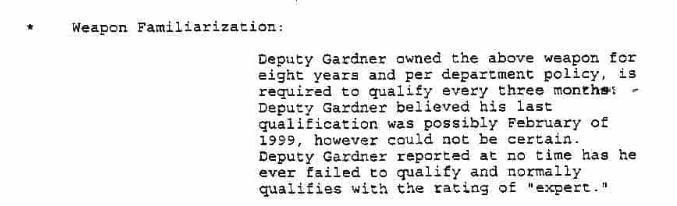
Gardner lied about qualifying in February.
Source: Neil Gardner’s interview, 11k, p.8070.
Gardner usually shot at the Sharpshooter level
As of November 10, 1998, Gardner had missed two handgun qualifications in the previous 12 months and had not qualified with his shotgun since March 1997. However, when he did go to the range, he shot at the Sharpshooter level.
From Gardner’s personnel files:
“B. Development Needs:
You have missed two handgun qualification quarters in the last twelve months. You also have not qualified with the shotgun since March of 1997. Being assigned as a C.R.O. requires additional effort on your part to make sure that you receive the required training. The shoot schedule is posted, making a copy or noting shoot days in your calendar should help you in this area. Fortunately, when you do shoot, you usually are at the Sharpshooter level.”
In 1999, Gardner missed three quarterly handgun qualifications, including the last quarter. As of November 1999, he had not qualified with his shotgun in two years. He went a total of three years without qualifying with his shotgun.
He only started qualifying consistently in 2005.
Source: Jefferson County.
Missing that many qualifications is a violation of department policy. Officers who fail to qualify aren’t allowed to carry their duty weapon or discharge it. Yet, Gardner did exactly that during the Columbine incident, lied about having qualified that quarter, and it was all swept under the rug. Because Gardner was an exemplary deputy, his policy violations were consistently overlooked.
Since Jefferson County didn’t issue handguns in .45 caliber, Gardner’s Sig Sauer P220 was likely a personally owned duty weapon. Officers who use personally owned duty weapons still need to qualify.
The JCSO policy on firearms qualifications
Section 306.3.2 PERSONALLY OWNED DUTY HANDGUNS
“Once approved, personally owned duty handguns are subject to the following restrictions:
(c) Prior to carrying the firearm, members shall qualify under range supervision and thereafter shall qualify in accordance with the department qualification schedule.”
Source: Jefferson County’s Sheriff’s Office SO Policy Manual, page 74.
Gardner Case Anomaly #11:
Gardner Reported Helping an Unidentified Student Shot In the Hip
There’s another contradiction between the official story and what Gardner and Marton described. Remember, Gardner and Marton were allegedly together nearly the whole time, yet reported events that hadn’t happened yet and made contradictory claims.
Gardner allegedly encountered an unidentified injured student just after 12:15 p.m., after hearing six muffled shots from inside the school.
“Deputy Gardner reported approximately five minutes after the last exchange of gunfire, he heard what he believed was approximately six muffled gunshots coming from somewhere inside the school. Around that same time frame, Deputy Gardner observed a juvenile male (not wearing a shirt) run out from the lower commons door in a southwesterly direction. Deputy Gardner remembered hearing the juvenile shout, ‘don’t shoot, don’t shoot.’ Deputy Gardner stated he believed the juvenile male was limping.
Deputy Gardner next directed Andy Martin [Marton] to exit his vehicle and respond to the west end of the parking lot in order to take a safer position.”
“Deputy Gardner stated he next confirmed with the juvenile male that he had been shot in what was believed the upper hip area. Deputy Gardner stated he subsequently returned to his vehicle and drove to the juvenile male’s location and had the victim enter his unit. Deputy Gardner then drove back to an empty parking space which faced north in the south student parking area. Deputy Gardner made efforts to confirm the victim’s condition appeared stable and did not require immediate evacuation for lifesaving measures. Deputy Gardner confirmed he remained with the victim until they were evacuated by SWAT officers who had arrived on scene.”
“Deputy Gardner estimated he remained with the victim for approximately one hour, during which time he did not hear additional gunfire and was subsequently evacuated by SWAT Units.”
Source: Neil Gardner’s interview, 11k, pp.8067-8076.
There are five big problems with Gardner’s story.
(1) Marton was still allegedly inside Gardner’s patrol vehicle when a student shot in the hip allegedly ran toward them yelling “don’t shoot,” but Marton’s interview contains a slightly different story. Marton reported seeing a student exit the cafeteria holding his leg and running into the parking lot. However, his interview does not say Gardner drove over to pick him up and reparked (as Gardner claimed), and he also doesn’t say that student entered Gardner’s patrol vehicle (as Gardner claimed).
(2) Gardner claimed he kept the gunshot victim in his patrol car for an hour when other wounded students were being taken to hospitals immediately with less serious injuries. This doesn’t make sense. Someone shot in the hip could have damage to major blood vessels, including the femoral artery and iliac vessels. Gardner couldn’t have known if the student was experiencing massive internal bleeding. The injured student was also at risk for shock and the bullet could have punctured his intestines. Keeping a gunshot victim in his car for an hour would have been a stupid move that would have gotten Gardner fired or sued. This event likely never happened at all.
(3) There is no injured student who matches the description of the kid Gardner allegedly helped. No injured student was shot in the hip and exited the cafeteria, nobody claimed to have sat in a patrol vehicle for an hour, and nobody reported being rescued by or sitting with Gardner.
(4) The news footage covers the exact area when Gardner claimed he encountered the injured kid, including Gardner’s car in the parking lot. Yet on the tape, Marton never exits Gardner’s patrol vehicle, Gardner’s car never moves, and no student is seen coming out of the cafeteria toward the parking lot.
(5) Gardner’s approximate time frame for this event is 12:15 to 1:15 p.m. Conveniently, forty minutes leading up to SWAT’s entry into the teacher’s lounge at 1:09 p.m. have been noticeably cut from the publicly released news footage. That’s forty minutes of missing footage taking place within the exact hour Gardner claimed to have encountered an injured student who doesn’t seem to exist. That’s even more reason to believe this event never happened.
Did Gardner pull Jayson Autenrieth into his patrol vehicle? If Autenrieth was shot while he was hiding behind cars in the parking lot nearby, this might make sense.
Marton said he was aware of Blair and Autenrieth hiding behind the red SUV. He said he made contact with them. If Autenrieth was shot by Gardner, Marton would have seen it. Did investigators just omit that part from Marton’s statement? Or was Gardner telling a solo lie? Did Gardner really help an injured student or was that story completely made up?
“Kim Blair estimated she along with Jayson Autenrieth remained behind the van for approximately two to three minutes. Kim Blair stated at that point she recalled hearing a campus supervisor known by the name of Andy Martin [Marton] call over to her and Jayson Autenrieth. Kim Blair sated at the time Andy Martin [Marton] made contact with them he was located on the far west side of the south senior parking lot along the north row of cars. Kim Blair reported when Andy Martin [Marton] made contact with them he was yelling, “Hurry, they’re coming back, hide.”
Source: Kimberly Blair’s interview, 11k, pp.698-708.
Gardner’s story of an injured student appears to be a cover for something else. What was Gardner really doing during that time?
The Channel 4 news helicopter footage should serve
as verification for Gardner’s account but it doesn’t—in fact,
the news footage destroys Gardner’s story
The Channel 4 news helicopter footage begins at approximately 12:02 p.m. when Jefferson County Deputy Del Kleinschmidt drove Engine 11 to the west doors to use as a shield for rescuing Richard Castaldo and Rachel Scott. The helicopter news footage shows clear shots of the parking lot, including the white Blazer and Gardner’s patrol vehicle. However, we never see SWAT approach Gardner’s vehicle like he claimed. The alleged leap-frogging of fifteen students by Gardner and other officers is also absent from the released footage.
The news footage released to the public has been heavily edited
Curiously, the publicly released version of the Channel 4 news helicopter footage on the tape dubbed the “Fire Department Training Video” cuts out at approximately 12:15, skips the next 40 minutes, and resumes at approximately 1:09 p.m. when out of nowhere, Jefferson County SWAT member Barry Williams and various Denver officers magically appear next to the teacher’s lounge where they can be seen pulling out the blinds and entering through the teacher’s lounge window.
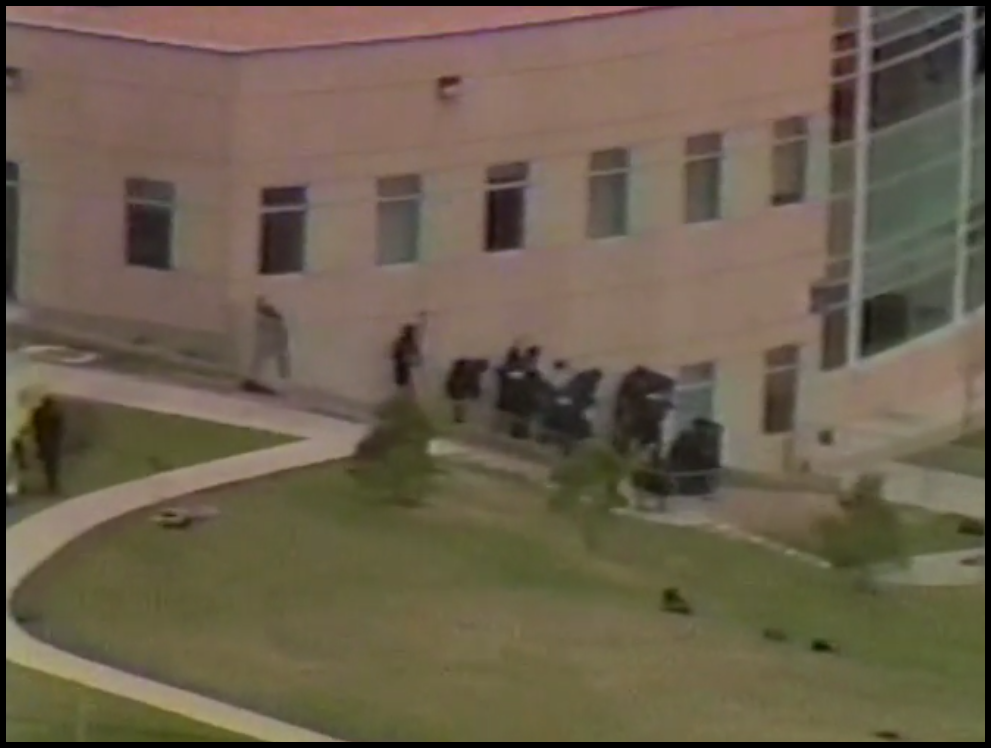
SWAT makes entry into the teacher’s lounge at approx.. 1:09 p.m.
Source: Channel 4 news helicopter footage.
If you don’t notice the jump cut in the video, here’s a comparison from one second to the next. Below are screenshots from 22:28 and 22:29:
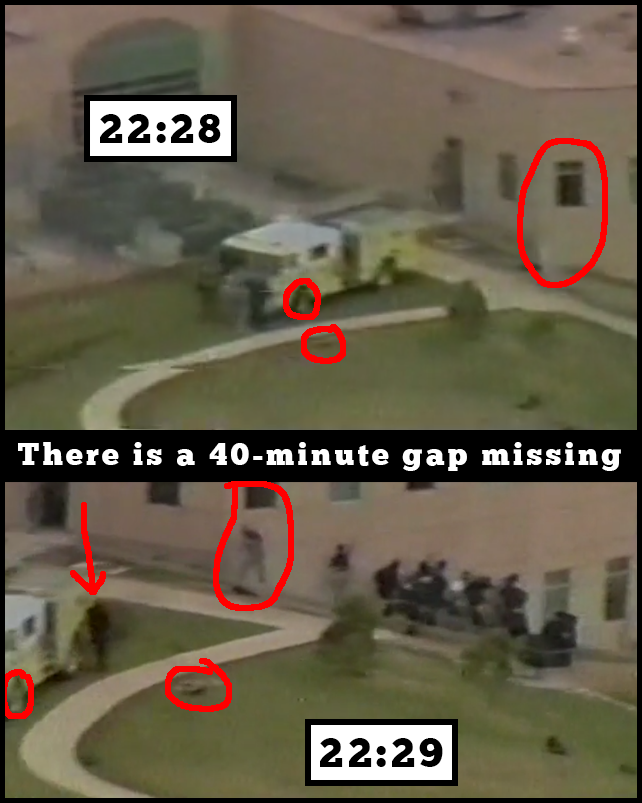
This jump cut eliminated approximately 40 minutes from the tape.
Source: Channel 4 news helicopter footage.
When you play the video, you’ll notice that before the cut at 22:28, the fire truck’s front tire lines up with Rachel Scott’s body and is actively being driven forward. After the cut, the fire truck has already stopped in a more forward position where the back tire lines up with Scott’s body, and one of the SWAT officers is already standing at the rear of the fire truck. He appears there out of nowhere. You can also see a student appear out of nowhere under one of the windows.
There’s another big cut at 27:36 that jumps to the scene of the fire truck and teacher’s lounge area.
There are forty minutes missing from the beginning of the tape. And even within that cut there are additional jump cuts. Since jump cuts occur after the only recognizable, independently timestamped event (when SWAT made entry into the teacher’s lounge at 1:09 p.m.), it’s impossible to pin down timestamps for every moment Gardner is visible in the lot.
But here’s what we do know based on what we can timestamp.
12:43 p.m. is the earliest time we can
verify Gardner’s presence in the lot
Just seconds after SWAT is seen placing Richard Castaldo on the front bumper of the fire truck, at approximately 12:43 p.m., the chopper pans out and shows Gardner behind the left side of his patrol car with five other people crouched down next to him.
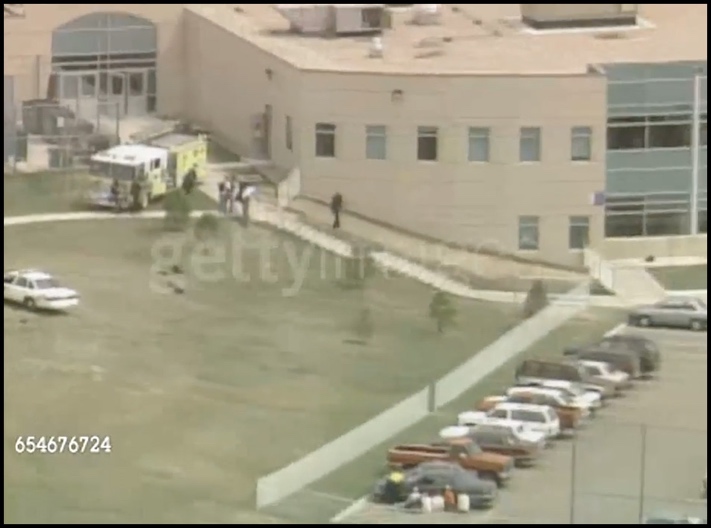
SWAT places Castaldo on the fire truck bumper at approx. 12:43 p.m.
while Gardner is at his patrol car with five other people.
Source: Channel 4 news helicopter footage.
While the original JCSO narrative places Castaldo’s rescue at around 12:34 p.m.-12:39 p.m., the El Paso investigation synchronized the Channel 4 footage to NIST time and placed O’Shea and the SWAT group moving toward the west doors to rescue Castaldo and Scott at 12:43 p.m.
The above images prove that Gardner couldn’t have been sitting in his patrol car with an injured student from 12:15 p.m. to 1:15 p.m. like he claimed. Why would Gardner leave a bleeding gunshot victim in his car to apply pressure to his own wound for an hour?
Several minutes later, at approximately 12:48 p.m., a single student appears already halfway through the parking lot running toward Gardner’s patrol vehicle. The student stops at the rear of Gardner’s car for less than two seconds and continues running to the camera’s right into another row of cars by the soccer field.
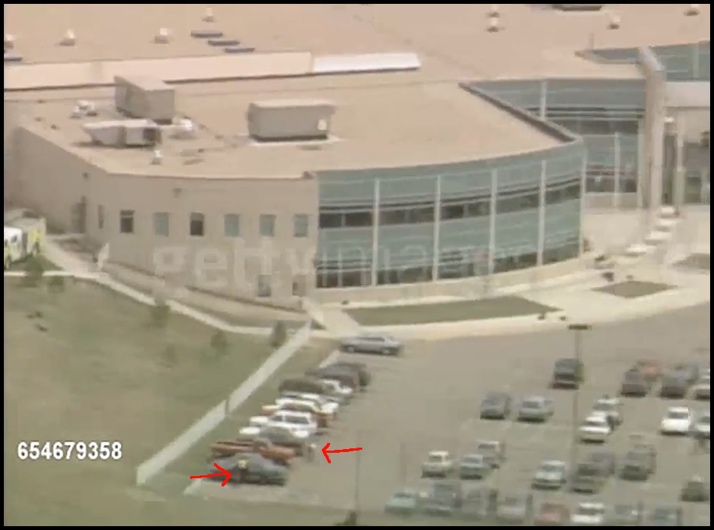
A single student runs to Gardner’s patrol car at approx. 12:48 p.m.
Source: Channel 4 news helicopter footage.
A few minutes later, at approximately 12:51 p.m., Gardner can be seen by the hood of the Blazer. It appears that the person who ran south along the adjacent line of cars came back to Gardner’s car. Even though the timing is wrong, we know this can’t be the alleged injured student Gardner reported helping because that student wasn’t wearing a shirt. This individual is wearing what appears to be a white shirt.
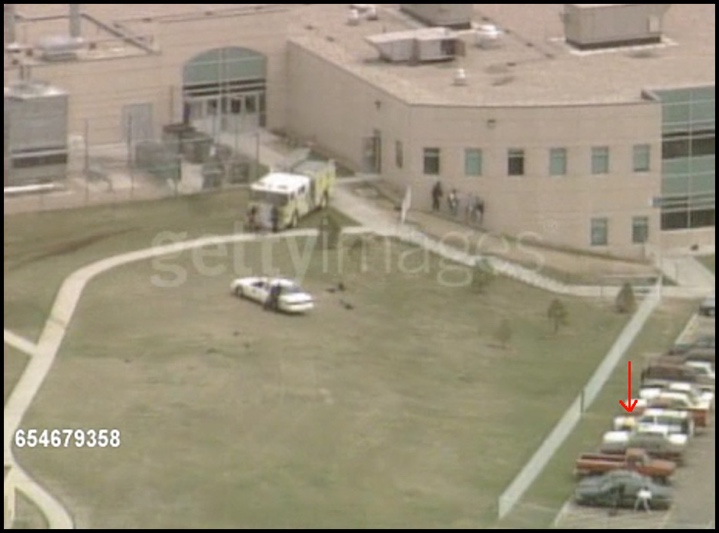
Gardner has moved to the hood of the Blazer at approx. 12:51 p.m.
Source: Channel 4 news helicopter footage.
At no time do we see SWAT come rescue someone from Gardner’s car like Gardner claimed.
Gardner claimed he helped the injured student during the 40-minute cut—is that a coincidence?
Now let’s look at Gardner’s supposed timeline alongside the identifiable news footage cuts:
12:15 p.m.-ish:
Gardner allegedly pulls an injured student who doesn’t seem to exist into his patrol vehicle.
The news footage cuts out.
1:15 p.m.-ish:
SWAT evacuates the wounded student who doesn’t seem to exist.
The news footage resumes.
The timing of the cut and the time the footage resumes is too convenient to pass off as a coincidence. Officials just happened to cut the entire timespan of when Gardner claimed to have done something that isn’t supported by any witness accounts?
No matter how you try to work it out, Gardner’s story doesn’t track.
Gardner appears at 12:43 p.m. and disappears around 1:49 p.m.
Gardner can be seen in the parking lot again just after 1:12 p.m., about three minutes after the news footage resumes. But at around 1:49 p.m., he’s gone. Where did he go?
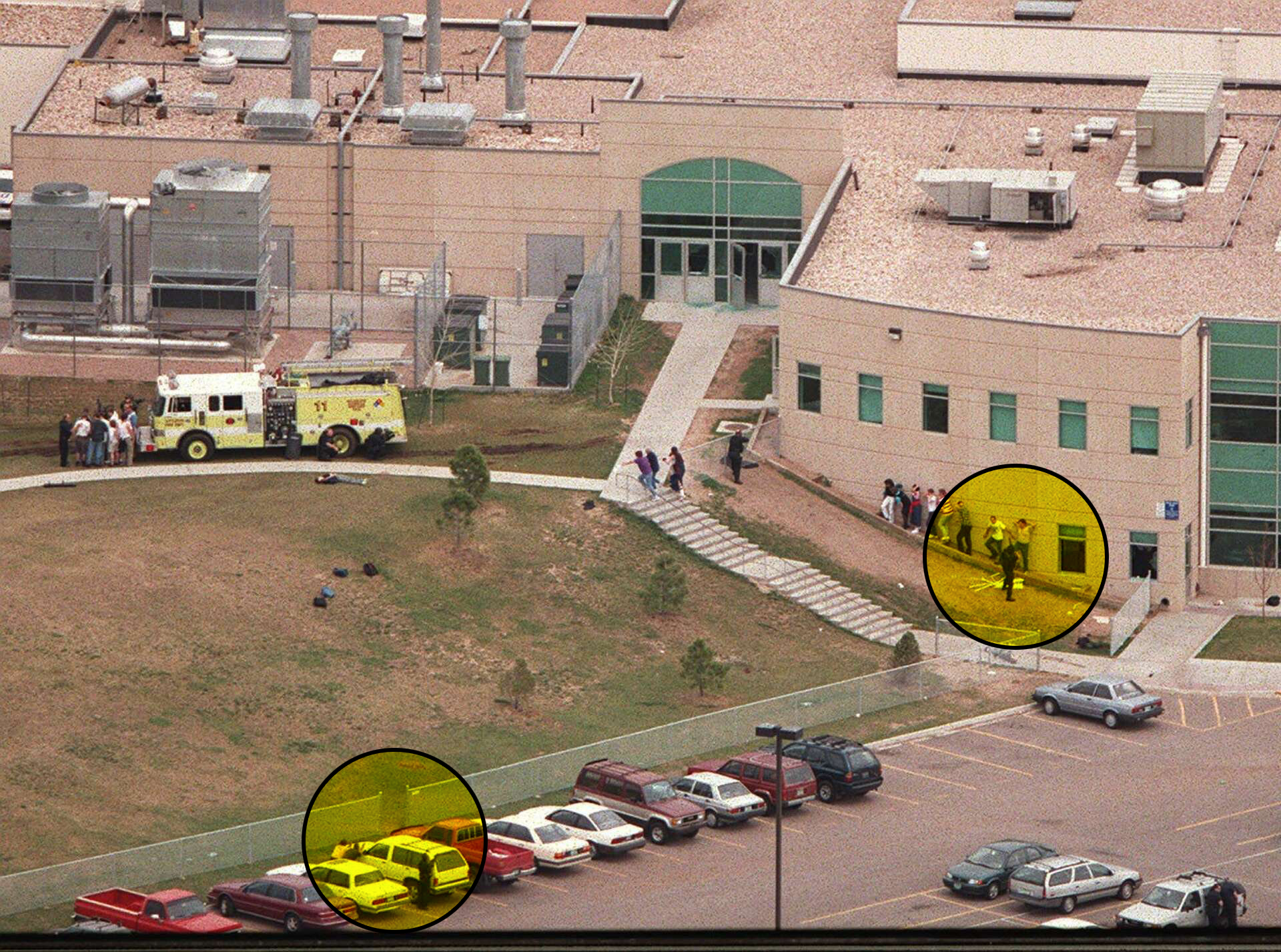
Gardner is visible by the Blazer with two other officers at approx. 1:12 p.m.
Source: Unknown
The above photo shows Gardner in his yellow shirt by the hood of the Blazer next to another deputy and a third deputy can be seen at the rear of the Blazer. Based on the scene, we know the time has to be approximately 1:12 p.m. because SWAT broke the window and ripped out the blinds at approximately 1:09 p.m. and three minutes later on the tape they started pulling students out. And while this scene doesn’t appear on the released news footage, the time the two officers spent at the back wheel of the fire truck was limited, so the timestamp of 1:12 p.m. is fairly accurate.
I have tried to pinpoint the above scene in the publicly released helicopter footage to no avail. While the poor quality video makes it impossible to identify what clothes the students are wearing to pinpoint this exact frame, the angle of the video suggests the photo either came from a different source, or was cut from the released footage.
The image above showing Gardner by the Blazer was captured from a different angle than the footage released of this scene by the Channel 4 news chopper. The Channel 4 chopper was hovering further to the left while filming this group of students.
In the images below, look at the red lines showing the angle of the path in front of the west doors. The top photo is the clear image of Gardner in his yellow shirt by the Blazer. The bottom screenshot comes from the publicly released Channel 4 news helicopter footage.
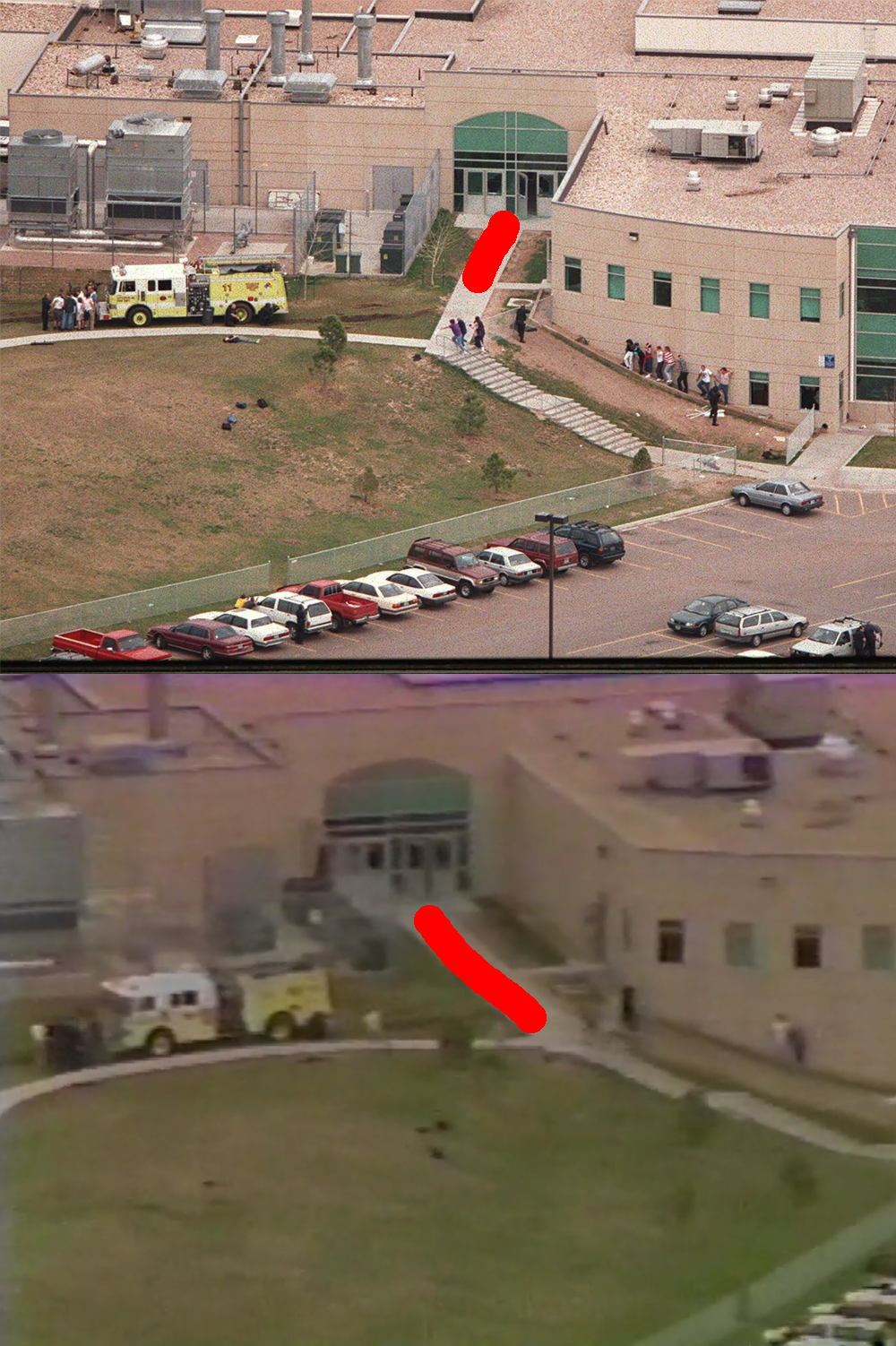
Source: Unknown & Channel 4 news helicopter footage.
Where did this clear, high-quality image of Gardner in the parking lot come from?
The Channel 4 chopper doesn’t appear to have ever been filming from this angle. I’ve played the footage in slow motion, frame-by-frame, looking for even just an angle that matches the angle of the photo showing Gardner in the parking lot and it doesn’t exist.
Even stranger is the fact that when you compare every frame of the helicopter footage to the still image of Gardner, there is no scene that has the same number of students along the wall while some students are running toward the fire truck with the two officers at the back tire. The scene in the clear photo was apparently cut from the public release. However, what’s important about this photo is that it shows Gardner in the parking lot at approximately 1:29 p.m., which is the latest time we can pinpoint him in the lot.
Thanks to additional clips of the news footage released directly by the media, we have an uncut 11-minute segment covering part of the period omitted from the public release. And Gardner isn’t visible in the parking lot during this time.
Timestamping Gardner’s presence in the parking lot—a breakdown
The following image was taken from the clear, 11-minute uncut segment of Channel 4 news helicopter footage that spans from approximately 2:14 p.m. to 2:25 p.m. This scene occurs at approximately 2:17 p.m. and shows Lakewood SWAT rescuing two individuals from the business area of the school just below the science room where Dave Sanders was located. Although it’s not legible in the photo, you can see the sign in the window that reads “1 bleeding to death.”
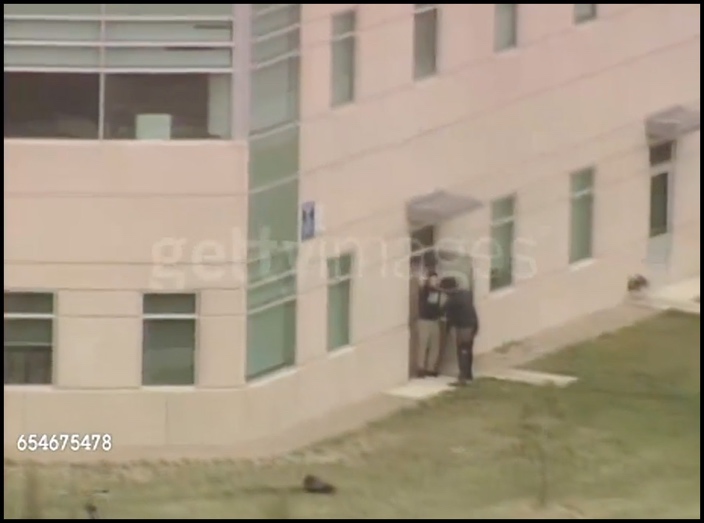
Lakewood SWAT rescues two individuals from the business wing at approx.. 2:17 p.m..
Source: Channel 4 news helicopter footage, 11-minute uncut segment.
Two minutes earlier, which would be approximately 2:15 p.m., the news chopper pans the parking lot with a clear view of Gardner’s police cruiser and the white Blazer, and Gardner is nowhere to be seen.
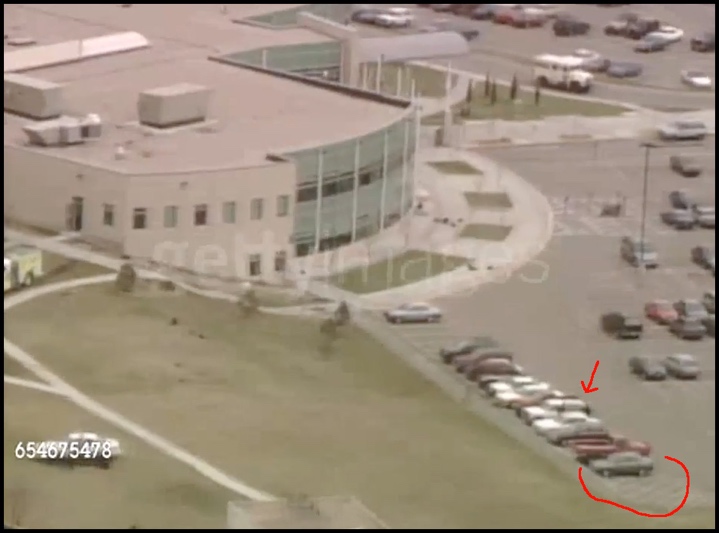
Gardner is not by the Blazer or his patrol car at 2:15 p.m. despite
Marton stating they held their positions until 3:00 p.m.
Source: Channel 4 news helicopter footage, 11-minute uncut segment.
At approximately 2:23 p.m., Gardner is still visibly absent from beside the white Blazer, while an unidentified Jefferson County deputy who has been there for hours remains by the rear of the Blazer. Gardner is absent despite Marton stating they both held their positions until 3:00 p.m.
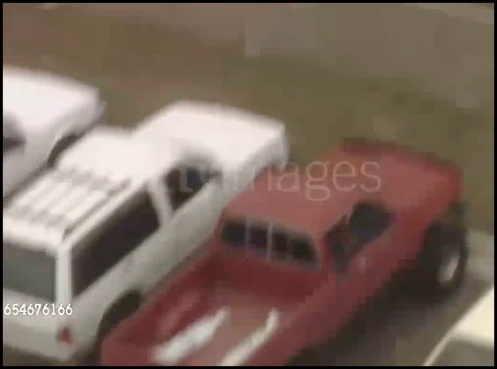
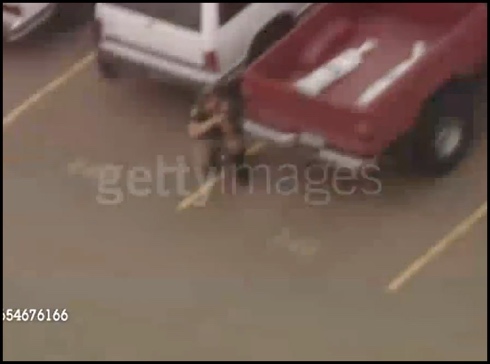
An unidentified Jefferson County deputy holds his position at the rear of the Blazer at approx.. 2:23 p.m..
Source: Channel 4 news helicopter footage, 11-minute uncut segment.
One minute later, at 2:24 p.m., two officers can be seen by the side of the Blazer and Gardner is still not there.
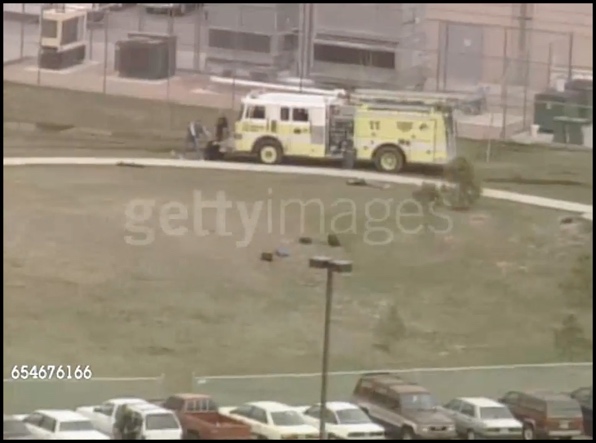
Two unidentified officers hold their positions at the rear of the Blazer at approx.. 2:24 p.m.
Source: Channel 4 news helicopter footage, uncut.
Was Gardner telling the truth when he said he was called to the command post at around 2:15 p.m.? It’s possible. But where was Gardner prior to 1:49 p.m.? We have no way to verify whether he was in the parking lot or not thanks to the poor quality footage we were given.
Contradictions regarding when and how Gardner left the parking lot
There’s another major discrepancy. Gardner’s story about when he was evacuated doesn’t match Marton’s story.
Gardner said SWAT rescued the injured victim after about an hour, which would have been approximately 1:15 p.m. Garder claimed he then watched the windows for an hour before being called to the command post, which would have been approximately 2:00 p.m. However, Marton told investigators he and Gardner held their positions until 3:00 p.m.
“Marton stated he believes that he and Deputy Gardner stayed in the same position until approximately 1500 hours, when they were advised to contact the command post in person to assist SWAT Team members with information.”
Source: Andrew Marton’s interview, 11k, pp.991-998.
Even stranger, Gardner appears to have said SWAT evacuated him with the injured student.
Deputy Gardner confirmed he remained with the victim until they were evacuated by SWAT officers who had arrived on scene.”
“Deputy Gardner estimated he remained with the victim for approximately one hour, during which time he did not hear additional gunfire and was subsequently evacuated by SWAT Units.”
Unless the officer who wrote this report was just terrible at constructing proper sentences, the last sentence says Gardner was evacuated by SWAT after remaining with the injured victim for an hour. That would have been at approximately 1:15 p.m.
So, which is it?
Gardner and Marton watched the windows until approximately 3:00 p.m. when they were called to the command post.
Gardner stayed with the injured student for an hour and then they were both evacuated by SWAT at approximately 1:15 p.m.
Gardner stayed with the injured student for an hour, the injured student was evacuated by SWAT at approximately 1:15 p.m., and Gardner watched the windows for another hour until he was called to the command post at 2:15 p.m.
It can only be one of these options.
Gardner Case Anomaly #12
A key event is missing from Gardner and Marton’s stories
According to the official narrative, “Gardner turned his attention to a group of 15 students huddled behind a vehicle in the parking lot just a car away from him. One at a time, he evacuated the students down the line of cars to the protection of the last car farthest away from the school and the shooters. Other students began to escape, some out a side door of the cafeteria, and the officers would “leapfrog” them back to Gardner or other waiting deputies.”
Source: Jefferson County Sheriff’s Office final report.
There is no group of 15 students visible in the parking lot on the publicly released news footage. And neither Gardner’s nor Marton’s interviews reference this “leap-frogging” rescue of fifteen students from car-to-car in the parking lot.
All of the students who escaped from the teacher’s lounge ran up the stairs and past the fire truck at the top of the hill. The news video shows about 30 students escaping from the side door of the cafeteria later on, but everyone runs up the stairs away from the parking lot. The closest to this event is when five students are seen crouching behind Gardner’s car and then they’re gone. Nobody leap-frogged them anywhere and no additional officers came over to Gardner to help.
Case Anomaly #13
Jayson Autenrieth May Have Been Shot
There’s another possibility that has to be considered, especially since the physical evidence doesn’t support Gardner’s account of firing over the hood of the white Blazer.
What if the story of the rifleman was constructed afterward to explain gunfire that actually had another source?
Gardner’s account is very specific. He said he took cover behind the engine block of the Blazer. He said the rifleman fired at least two volleys of shots in his direction, and he returned fired over the hood eight times. That story—though unsupported by ballistic evidence and an obvious lie given that two of his fired bullets were found in the library—gives investigators an easy explanation for the damage to the Blazer and Gardner’s expended ammunition.
And Gardner’s claim that he thought he hit the rifleman provides a vague, uncommitted explanation for his mushroomed bullet that appears to have penetrated flesh. But what if that bullet didn’t hit a suspect?
The contradiction between Gardner’s account and the recovered ballistic evidence is what makes the rifleman story unbelievable. All eight of Gardner’s shell casings were located in the wrong place for having been ejected while he fired over the hood. They were considerably farther back in the parking lot. And Gardner himself claimed the glass from the passenger side mirror shattered over his shoulders. Not only was Gardner never on the passenger side of the Blazer, but investigators didn’t document damage to the mirror.
A natural question arising from Gardner’s obviously constructed narrative would be: why would Gardner lie about where he was when he shot at the rifleman? What difference would it make if he shot from the front or back of the Blazer? And what difference would it make if he was already inside the school’s hallway when the incident began?
Unless Gardner was involved in something that had to be covered up, where he was and where he shot from wouldn’t make a difference. That’s why the real question is whether he shot at a rifleman at all. Because if Gardner never shot over the hood of the Blazer (according to ballistic evidence, he did not), then it’s hard to believe he shot at a rifleman. Based on all the evidence, it’s possible and even likely that someone plotted all eight of Gardner’s spent shells by the Blazer on the evidence map without realizing they should have been located toward the front.
The fact that the ballistic evidence from the Blazer was never collected and processed during the investigation prevented one of the most basic questions in the case from ever being answered:
Whose bullets hit the Blazer?
Perhaps leaving this question unanswered was intentional. Because if investigators weren’t interested in collecting the bullets from the Blazer, they probably already knew exactly who fired the shots and wanted to keep it secret. But were they fired by an additional suspect or someone else?
Here’s a possibility to consider. What if the gunfire attributed to the rifleman actually came from Gardner when he exited the school out the west doors at the start of the incident? If he was already inside the school, which seems to be the case, and all the action was starting outside the west doors, that’s exactly where he would have gone first.
What if Gardner encountered the rifleman in a different location, and while aiming for him, ended up hitting the Blazer and accidentally shot someone else within the line of fire of the Blazer?
What if the story of the rifleman was a cover story for an injury Gardner caused that investigators wanted to hide from the public?
We know Gardner shot someone who has never come forward. If Gardner shot a suspect, it wouldn’t make sense for investigators to hide that fact, unless the suspect was an accomplice they’re covering for. While that’s possible, there’s another possibility backed by strong evidence.
It’s very possible that Gardner shot a student he either mistook for a suspect or accidentally hit while aiming for a suspect either in front of the west doors or in the parking lot. This possibility isn’t far-fetched when you consider the fact that an unidentified student with a shoulder wound was seen entering the cafeteria around the same time Gardner said the shootout happened. And according to the accounts of every injured student, none of them entered the cafeteria after being shot outside.
Did Gardner shoot Jayson Autenrieth?
When I went searching for a possible student shot in the shoulder, I found one strong possibility: Jayson Autenrieth.
Just like the “rifleman,” Autenrieth had short blond hair and was wearing a white t-shirt and blue jeans that day. And he told investigators he took cover behind some cars in the senior lot around the same time a blond student wearing a white t-shirt and blue jeans was seen entering the cafeteria with a bloody shoulder/arm wound.
That wounded student may have been Jason Autenrieth, and if Gardner was coming out of the west entrance shooting at a suspect in the parking lot, Gardner could have shot Autenrieth while he was taking cover behind some cars.
Establishing that Autenrieth may have been shot
Two witnesses independently saw someone matching Autenrieth’s description enter a south cafeteria door with a bloody arm/shoulder wound.
Tanya Worlock
“WORLOCK stated she was in the cafeteria near the vending machines when she heard popping noises like firecrackers. She saw a person stagger into the cafeteria holding his shoulder. When he pulled [his hand] away, she saw lots of blood coming from a wound. A teacher told everyone to get on the ground.”
“A kid came through the door. He was shot in the shoulder. He was pulled into the teacher’s lounge.”
Source: Tanya Worlock’s interview, 11k, pp.4768-4774.
Was this bleeding student Autenrieth?
Worlock was near the teacher’s lounge by the door where Sean Graves was located and lay injured just outside the door, but Graves didn’t stagger into the cafeteria holding his shoulder. No other wounded student was located in that area. And no known injured party was pulled into the teacher’s lounge according to the official story.
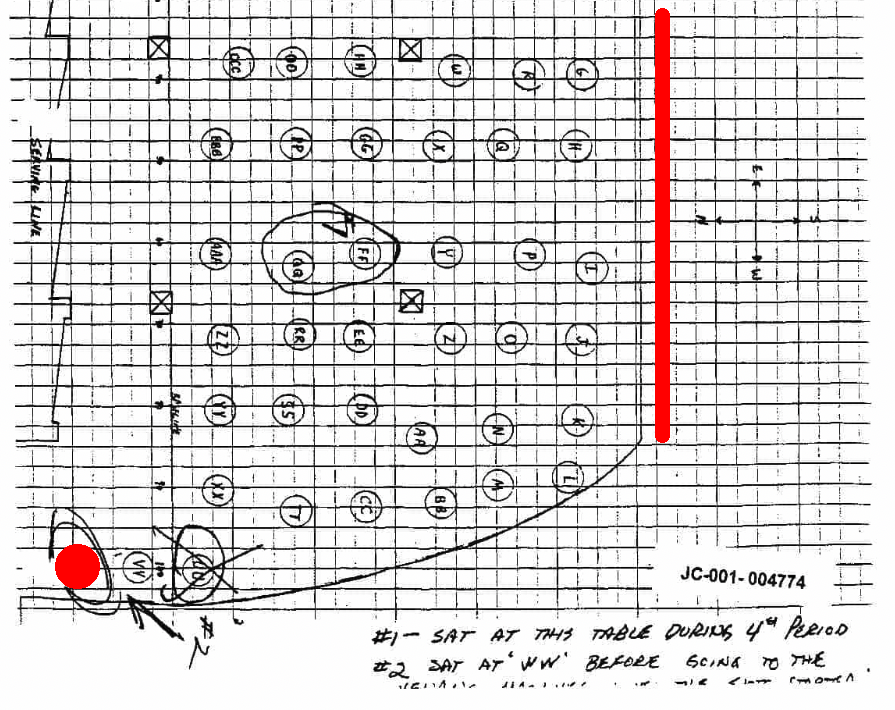
Red dot: Worlock’s location.
Red line: six south cafeteria doors.
Source: 11k, p.4774.
Would Worlock have been able to see Autenrieth enter the cafeteria?
Yes. From her vantage point, Worlock would have been able to see Autenrieth enter the cafeteria. He entered from the first door on the left circled in the photo below:
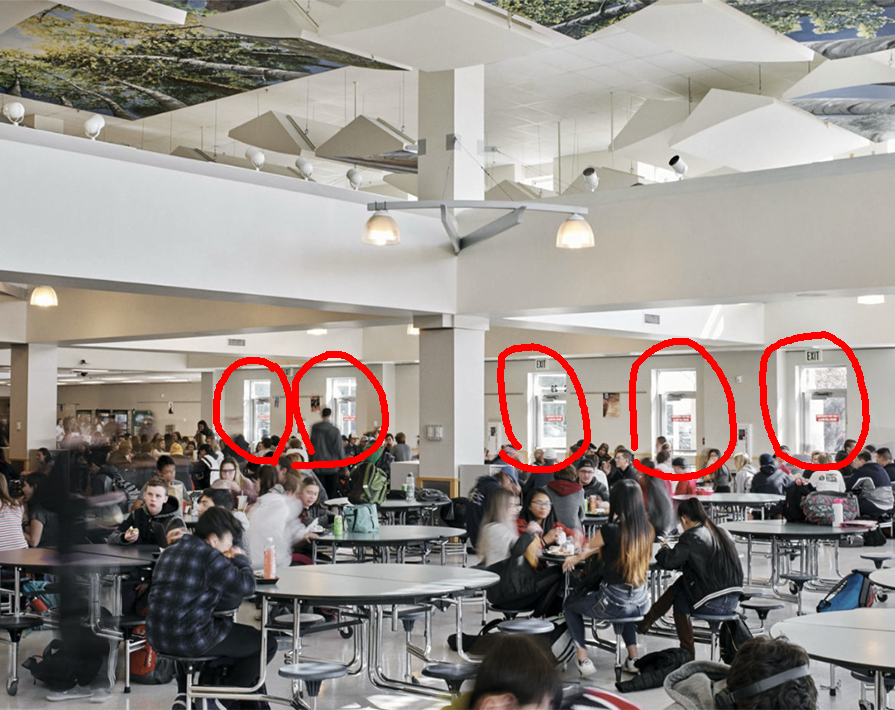
A view of the 6 south cafeteria doors from near the vending machines and
teacher’s lounge, approximately where Worlock would have been.
Source: unknown.
The vending machines were actually further left of this photo and a little deeper into the cafeteria, much closer to the door where Autenrieth entered.
Courtney Reynolds
“As she was getting under the table, she recalls seeing an unidentified white male enter the cafeteria from the south doors. She told me the person had short blond hair, was wearing a white t-shirt and blue jeans. She could see that the individual was bleeding from one of his arms, and once the party entered into the cafeteria, he sat down right by the door that he just entered in.”
Source: Courtney Reynolds’ interview, 11k, pp.4183-4187.
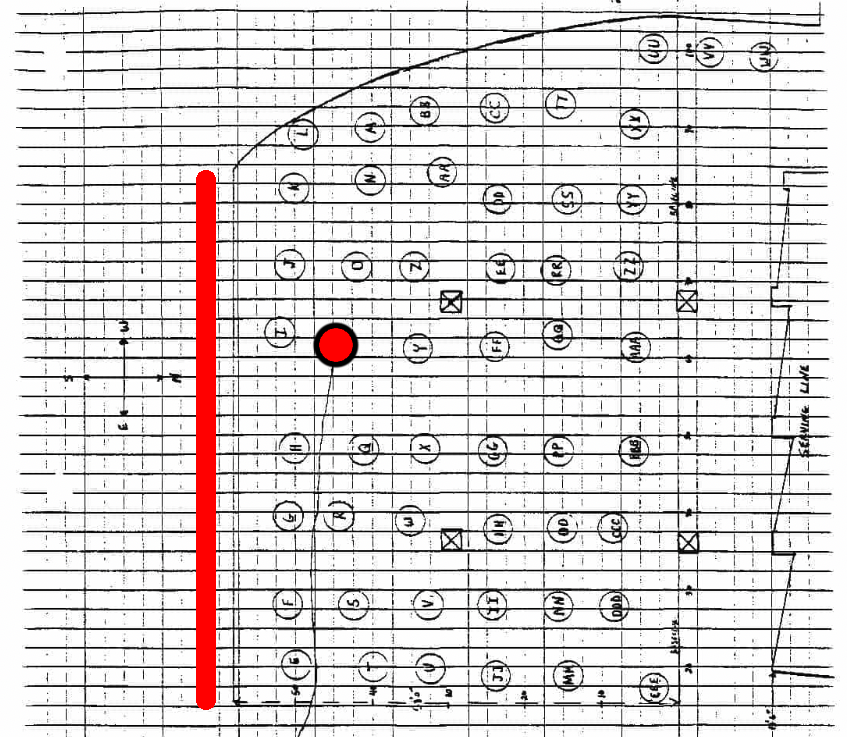
Red dot: Reynold’s location.
Red line: six south cafeteria doors.
Source: 11k, p.4187.
Was this bleeding student Autenrieth? It’s very possible. Blair, who was with Autenrieth and Hochhalter, said he entered the cafeteria through the same door they previously exited, which was the first of the six doors on the left from inside the cafeteria. Reynolds could have seen him come through this door from her location.
Although the boy with the bloody arm/shoulder wound was never named by Worlock or Reynolds, there is one witness account that places Autenrieth in the cafeteria with bloody hands by name.
Diana Barker
“Diana stated a friend of hers, Kim Blair, ran in through one of the south cafeteria doors and went to Mary [Baribeau] who was seated at Diana’s table. Kim started to shake Mary and she was screaming hysterical [sic] that she needed help. They looked outside and saw Ann [sic] Marie bent over and a boy by the name of Jason behind her appearing to try to help her up. Diana said it looked like he was trying to give her the Heimlich maneuver… Diana stated Jason came in through the door at this time with blood all over his hands. She stated he collapsed near the cafeteria door.”
Source: Diana Barker’s interview, 11k, pp.2422-2425.
Barker saw Autenrieth with bloody hands in the cafeteria, but the events she described contradict Autenrieth’s story. Barker placed Autenrieth outside helping Hochhalter alone while Blair ran into the cafeteria asking for help. She said Autenrieth entered the cafeteria after helping Hochhalter, which is not what Autenrieth said happened.
According to Autenrieth, he and Blair ran into the cafeteria together before even knowing Hochhalter was shot. When they realized she was injured, they both exited the cafeteria to help her. Once Autenrieth dragged Hochhalter to the side of the building, he and Blair both ran into the senior lot. Autenrieth never re-entered the cafeteria after being exposed to Hochhalter’s blood, and Blair did not re-enter the cafeteria either.
There’s another problem. Kimberly Blair’s story doesn’t match Autenrieth’s or Baker’s story. While Autenrieth reported both he and Blair entered the cafeteria together and didn’t know Hochhalter had been shot (he said they had all gotten up to run), Blair reported that Hochhalter was shot and fell over while they were all still sitting down together. She also claimed she didn’t know where Autenrieth went.
“Kim Blair stated she was uncertain where Jayson Autenrieth had gone after Ann Marie Hochhalter was shot reiterating “I ran inside the commons.”
Source: Kimberly Blair’s interview, 11k, pp.698-708.
Blair said at some point Autenrieth grabbed her by the arm in the cafeteria to get her attention and told her to stay in the commons. She followed him outside instead, and that’s when he dragged Hochhalter to the side of the building. Blair reported that she had stayed back at the furthest south cafeteria door while he moved Hochhalter alone. Then, she said Autenrieth came over to her and pushed her back into the cafeteria, and then Autenrieth followed her inside, which placed him in the cafeteria a second time, this time with potentially bloody hands. However, Autenrieth said he and Blair immediately ran into the parking lot after dragging Hochhalter to the side of the building.
In another portion of her interview, Blair’s story matches Autenrieth’s and omits their re-entry into the cafeteria.
After describing watching two male students dressed in black pulling out guns from duffel bags, Blair reported, “Two male students on the steps fell only two feet away from me. Ann Marie was shot in the back. Moments before I had made eye contact Ann Marie fell. I went inside to get help. We were told to stay down. I returned outside to help Ann Marie. Jayson was dragging her to safety. Jayson and I huddled against the side of the building… Jayson and I ran west into the parking lot and hid behind a light blue van.”
Source: Kimberly Blair’s interview, 11k, pp.698-708.
There’s another problem with Blair’s story. She claimed that the two boys who were shot on the stairs were just “two feet” from her. They were actually closer to 30 feet away. Even if she was estimating the distance, two feet would suggest they were right in front of her.
Were Autenrieth’s hands bloody from helping Hochhalter?
At first, it seems reasonable to conclude that the wounded individual seen by Barker, Worlock, and Reynolds was Autenrieth, and the latter two mistook blood transfer on his shirt for a bleeding shoulder/arm wound.
The problem with explaining Autenrieth’s bloody hands as having come from helping Hochhalter is that his own account never places him inside the cafeteria after helping her.
These are not small discrepancies that can be written off as “confusion.” Someone isn’t telling the whole truth.
Where Autenrieth, Blair, and Hochhalter were allegedly located
The official narrative places Autenrieth outside the cafeteria with Kimberly Blair and Ann Marie Hochhalter when the shooting began. In the image below, the senior parking lot is partially visible and extends further to the left.
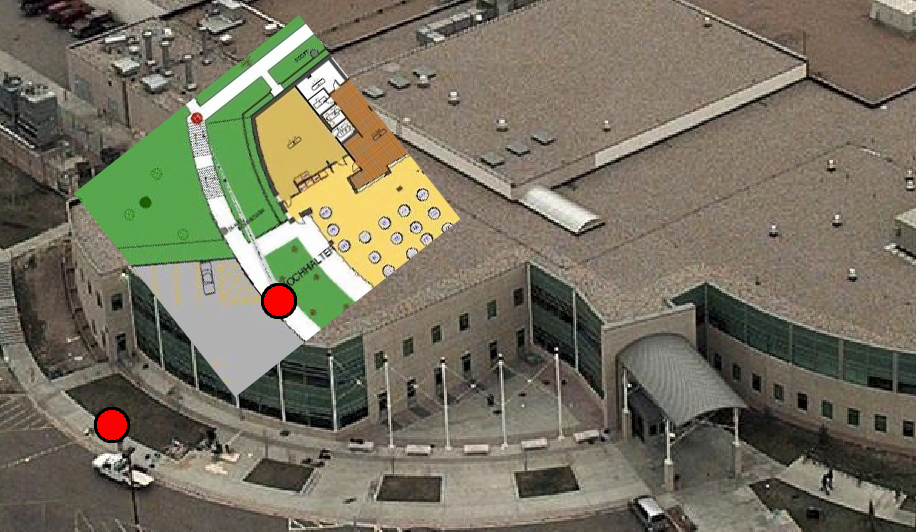
Red dots: Autenrieth’s approximate location with Blair and Hochhalter.
Source: Jefferson County.
There are three backpacks in the above photo, which might belong to Hochhalter, Blair, and Autenrieth. The location marked is an approximation based on Jefferson County’s diagram.
In the image below, Autenrieth’s location would be just about 20-30 feet to the right.
Source: Channel 4 news helicopter footage.
Something’s fishy about Autenrieth’s account
Autenrieth said he watched the gunmen for several minutes before anyone in his group attempted to flee. According to his account, he saw Harris remove a long gun from a duffel bag and watched bullets strike the ground near where he was sitting. He then watched Klebold unzip another bag, remove the TEC-9, and fire toward the West entrance. He saw Klebold reload a large magazine, watched Harris reload, and then watched Harris fire down the stairs, striking Dan Rohrbough and Lance Kirklin.
Only then, according to Autenrieth, did the group get up and run.
He estimated that approximately three to four minutes had passed. This lengthy hesitation from everyone in the group makes his story questionable.
Autenrieth explained that he initially thought the shooting was a senior prank. But that’s hard to reconcile with the event he described. He wasn’t describing distant popping noises that could be mistaken for firecrackers. He described watching two armed individuals firing a shotgun and semiautomatic pistol at close range that he believed was fully automatic. He saw bullets strike the ground where he was sitting, watched magazines get changed, and watched people get shot. And everyone in his group waited four minutes to get up and run?
Most importantly, Autenrieth’s timeline doesn’t fit with the timestamped chronology of Harris and Klebold’s movements. Like Gardner, Autenrieth described gunfire coming from the library far earlier than the 911 call documents.
He also told the El Paso County Sheriff’s Department that he saw Gardner on campus before the shooting began. This was omitted from his interview summary in the 11k report.
“Only Jason Autenrieth and Keith Parkinson believed they saw a law enforcement officer on scene before the shooting started. Both Jayson Autenrieth and Keith Parkinson think the school resource officer, Deputy Neil Gardner, may have been on scene.”
Source: El Paso Report Summary, p.28.
What is Jefferson County hiding about Gardner’s presence at the school earlier than he claimed? What did Gardner do that required such an elaborate concealment of his location and actions that day?
Autenrieth and Blair took cover behind cars in the senior lot
After dragging Hochhalter to the outside wall of the cafeteria, Autenrieth said he took cover in the senior lot behind some cars.
“Autenrieth stated that after putting Hochhalter near the building, face down, to protect her body from further explosions, he and Blair ran towards the parking lot to hide behind a vehicle.”
Source: Jayson Autenrieth’s interview, 11k, pp.669-672.
“Anne Marie Hochhalter was shot as she stood to run toward the cafeteria from where she was seated with friends at the curb by the senior parking lot. A friend dragged her away from the gunfire to the cafeteria wall. He left Hochhalter near the building and ran into the parking lot, hiding behind vehicles in the senior lot.”
Source: Jefferson County Sheriff’s Office final report.
Autenrieth would have been directly in the
line of fire when shots hit the Blazer
If Gardner shot into the senior parking lot from the west entrance and hit the Blazer, Autenrieth would have been in the exact line of fire where those rounds would have traveled.
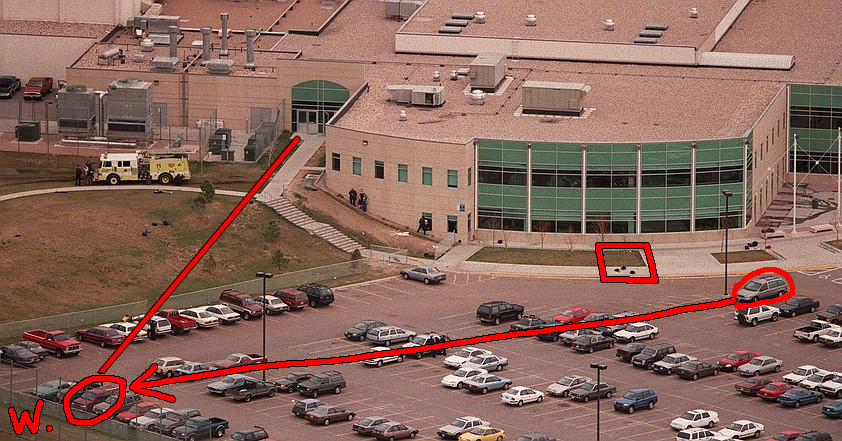
This image shows: (1) Autenrieth, Blair, and Hochhalter’s original location (red square).
(2) The light blue van (circled right) Blair and Autenrieth hid behind first.
(3) The red SUV (circled left).
(4) The possible trajectory of a bullet fired from the west doors that could have hit both the white Blazer and someone standing near the red SUV.
Source: Channel 4 news helicopter footage.
Autenrieth took cover behind a red SUV that would have been directly in Gardner’s line of fire if he fired from the west entrance through or around the Blazer.
Interestingly, someone did fire shots at the red SUV. Blair reported hearing a bullet go by that she said almost hit her while she was at the SUV with Autenrieth. Autenrieth could have taken one of those bullets.
“Kim Blair told IO at one point while located behind the red/maroon ‘SUV’ she recalled hearing a ‘bullet go by me.’ Kim Blair stated she believed that occurred at a point when she was trying to make observations related to Ann Marie Hochhalter. Kim Blair stated after almost being struck by a bullet she then concealed herself behind the SUV and did not look out again.”
Source: Kimberly Blair’s interview, 11k, pp.698-708.
If Autenrieth was shot by a suspect, even an unidentified accomplice, there would be no reason to conceal his injury. But if he was hit by friendly fire, that would be strong grounds for a cover-up.
Is it just a coincidence that Autenrieth:
Matched the description of the person Gardner claims he thought he shot in the shoulder and multiple cafeteria witnesses saw someone matching his description enter the cafeteria with a shoulder/arm wound?
Would have been in the direct line of fire if shots were fired from the west doors at the Blazer?
Told a story that doesn’t match the person he was allegedly with (Blair)?
Autenrieth and Blair don’t agree on how many times they entered the cafeteria or whether Hochhalter was shot while sitting or after standing up and running away. Those are big details to get wrong. But there’s another issue that needs to be addressed. If Autenrieth was injured by Gardner’s stray bullet and that was covered up, Autenrieth would tell an altered version of events in order to conceal where he was when he was shot. Discrepancies in his story compared to Blair’s make sense from that lens, especially if they were together when Autenrieth was shot.
If you think you can trust Blair’s version of events to confirm that Autenrieth wasn’t shot, think again. Her story appears to have been fabricated to fit the official narrative. And based on how she tells her story currently, it doesn’t seem like she’s recalling a genuine memory—it appears that she’s reciting a script, and after all these years she’s lost the plot.
Kimberly Blair’s story deserves serious scrutiny
When you examine the way Blair currently recounts her alleged experience at Columbine, it becomes apparent that her entire story has always been a lie.
While some witnesses do tend to embellish and add small details to their memories over time, they don’t alter the core aspects of their story. The details Blair has added to her account aren’t minor. She’s telling a completely different story. When an entirely new story emerges, that’s a sign that the individual is not recalling a memory at all.
Originally, Blair said when she ran into the cafeteria she heard a teacher she couldn’t identify telling people to get down. At that time, she told her friend, Mary Baribeau, that Hochhalter had been shot. This is exactly what Diana Barker said happened. But Blair has a new story.
During a 2023 event organized by Firehouse Training+, Blair switched the main character in her story from Baribeau to Sanders. She said she ran into Dave Sanders when she entered the cafeteria and told him Hochhalter had been shot.
“I ran inside the building. The first person I ran into was Dave Sanders, who was one of our teachers. And I told him, ‘Ann Maries been shot! Ann Marie’s been shot! I need help! Someone help me!’ And he told everybody to get down.”
Source: “Night of Survivors” panel organized by Firehouse Training+, HUGS, Inc., and the Southold Town Fire Chief’s Council at Mattituck High School.
https://patch.com/new-york/northfork/u-s-mass-shooting-survivors-speak-li-its-going-happen-again.
Blair then said she ran into the library to find her twin sister, and when she got into the library she saw students triaging each other because paramedics weren’t allowed inside.
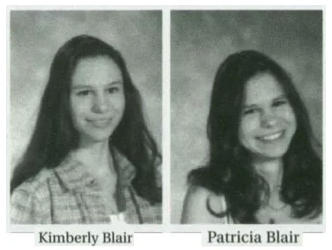
Kimberly Blair and her twin sister, Patricia Blair.
Source: Columbine yearbook, Rebelations.
This entire event of her running into the library is brand new to her story and is absent from both her original account and the official narrative. Remember, she initially told investigators that after exiting the cafeteria, she and Autenrieth ran directly into the parking lot where they hid behind cars until they were rescued by Marton.
During her 2023 speech, when recounting what she saw in the library, Blair said, “The EMTs and first responders weren't allowed in, so the kids did triage themselves. The girls took off their shoes and made tourniquets out of their socks. The boys took off their shirts to hold bloody wounds.”
However, none of this happened in the library. Triage was done outside by Deputy Taborsky’s patrol vehicle where he and Smoker were helping injured library students. That’s where the boys took off their shirts to use as tourniquets. Deputy Rick Searle then transported groups of students to the Caley/Yukon triage area for further triage. (At least that’s where they all pretended to do triage since this incident was just a drill).
Blair never went into the library looking for her twin sister. At the time she claims to have run into the library, nobody had been shot yet. The shooters were still outside.
According to Blair, she watched Harris and Klebold carry their bags up the hill, pull out their guns, and fire the first shots. The first shots were fired at approximately 11:17 a.m., and the library massacre wouldn’t start until about ten minutes later, and Harris and Klebold didn’t leave the library until approximately 11:40 a.m.
In order for Blair’s entry into the library to be true, she would have had to wait 20 minutes before heading over there. The timing doesn’t work.
In her 2023 speech, Blair also claimed that when she walked out of the library she saw Lance Kirklin get his jaw blown off. That’s not possible. According to the official story based on witness accounts, Kirklin was shot in the jaw before Harris and Klebold even entered the library.
Another issue with Blair’s new story is that she claimed after she saw Kirklin get his jaw shot off, she went back into the building again. Then she ran outside again and started screaming profanities at the gunmen, and they started shooting at her.
Blair has a huge smile on her face and appears to be boasting about how she stood up and cussed out the shooters using “every” amount of profanity she could think of and “yelled and yelled and yelled” at them.
Blair has a huge smile on her face while she recalls cussing out the shooters.
Source: “Night of Survivors” panel organized by Firehouse Training+, HUGS, Inc., and the Southold Town Fire Chief’s Council at Mattituck High School.
Even if her timing was possible, it’s unrealistic that she would confront two gunman with so much aggression after watching them shoot her friend, seeing the aftermath of the library massacre, and watching them blow someone’s jaw off.
It’s clear that she’s just telling wild stories because she has no real memories to draw from.
Blair’s embellishments don’t seem like an authentic case of false memory. It also doesn’t seem like she’s telling a new story to get attention. It appears that her story has been false from the start, she’s forgotten her original lines, and has gone so far off-script she’s in the weeds. Since most people would never question a shooting victim, she gets away with it.
If we can’t trust Blair’s account, we can’t trust Autenrieth’s account either. But let’s examine the rest of her story. Because if Autenrieth was accidentally shot by Gardner, that could be the basis for all the lies he told about where he was that day, why the dispatch tapes and news footage were heavily edited, and the reason investigators never released the location of most of his bullets.
Autenrieth’s location in the parking lot according to Blair
According to Kimberly Blair, she and Autenrieth hid behind a light blue van that was close to their original location, and then they ran toward the west fence and hid behind a red SUV.
Looking at an aerial shot of the parking lot reveals their path:
This image shows: (1) Autenrieth, Blair, and Hochhalter’s original location (red square).
(2) The light blue van (circled right) Blair and Autenrieth hid behind first.
(3) The red SUV (circled left).
(4) The possible trajectory of a bullet fired from the west doors that could have hit both the white Blazer and someone standing near the red SUV.
Source: Channel 4 news helicopter footage.
If Gardner was inside the school when the shooting began, exited the west doors to check on the action, and he fired his weapon at what he thought was a suspect in the parking lot, some of his shots could have traveled past the Blazer and hit someone exactly where Autenrieth was located by the red SUV.
Gardner Case Anomaly #14:
Are Gardner’s discrepancies are connected to the Jim Taylor/Daniel O’Shea/Daniel Rohrbough controversy?
There’s another controversy involving police gunfire at Columbine that may be relevant to the unanswered questions surrounding Neil Gardner. It centers on Arapahoe County Deputy Jim Taylor, Denver SWAT team Sergeant Daniel O’Shea, and the death of Daniel Rohrbough.
Initial rumors claimed Rohrbough was killed by friendly fire
Shortly after the incident, rumors began circulating that Daniel Rohrbough was killed by friendly fire after O’Shea told people he was concerned that he may have hit a student when he fired into the library to provide cover fire. Taylor never mentioned O’Shea by name, and he never said he saw an officer shoot Rohrbough. That conclusion was drawn entirely by the Rohrbough family.
The Rohrboughs initially tried to get the county coroner to hold an inquest but their request was rejected on the basis that an inquest can only determine the manner and cause of death, which wouldn’t satisfy the questions they’re looking to answer.
Eventually, the El Paso County Sheriff’s Department conducted an independent investigation and concluded that a shot from Harris’ Hi-Point rifle killed Rohrbough. But when you analyze the underlying evidence separate from the conclusion, there’s a much bigger story to unpack.
What Jim Taylor claimed He saw
Jim Taylor never said he saw O’Shea or any cop shoot Daniel Rohrbough. He described seeing a boy fall on the outside steps as if he had been shot. When he found out the body at the bottom of the stairs was Daniel, he assumed Daniel was the boy he saw fall.
Rohrbough taped a conversation between himself, Jim Taylor, and Jim’s wife, Pam. An excerpt was released by investigators and Brian Rohrbough played a portion of the tape for an episode of Good Morning America that aired on January 3, 2002.
Jim Taylor: “What I seen was a boy coming down the sidewalk, you know, kind of running, you know a fast trot but there was 20 or 30 other kids around... They were just running in mass chaos and I seen a boy drop... It was Dan and I didn't know that until I seen the photo the next morning in the newspaper that it was the boy that I seen.”
Jim Taylor: “Kids were still running out of the building and, you know, you could hear glass breaking, you could see kids runnin’ everywhere and that's when I see the boy comin’ down the sidewalk... and I see him just fall down. That's the first thing I told Pam was that... I seen some kid got shot.”
Pam Taylor: "He did, no kidding, he walked in that night and he says, "I just, I'll never get rid of this," he goes, "Seein' this."
Source: Audio recording made by Brian Rohrbough
After this tape was made known, Taylor was placed on administrative leave. Two days later on January 9, 2002, Arapahoe County Sheriff Pat Sullivan fired Taylor citing five policy violations.
When the dispatch transcripts and officer interviews were reviewed, investigators found that Taylor was never assigned to the west side of the school and definitively arrived after Daniel was killed.
Still, the Rohrboughs insisted that Taylor wasn’t lying. They claimed that Taylor got far too many details correct when sharing what he saw that day—things that coincide with evidence that goes against the official narrative.
The Arapahoe County dispatch tapes would have been enormously helpful in determining Taylor’s arrival time and whereabouts, but they were transcribed and then allegedly destroyed a year after the shooting.
The Taylor/Rohrbough Family Connection
Keep in mind that Jim Taylor was a family friend of the Rohrboughs. The more you research this case, the more you’ll notice that everyone involved in the major controversies are closely connected or are family. For instance, “rooftop repairman” Chris Clarke is part of the Hochhalter family by marriage. The narratives originating from these close connections are what tends to keep all the anomalies in the official story together. Witnesses outside of these circles tend to tell an entirely different version of events. Just keep this in mind because this part of the rabbit hole is deep.
The Rohrboughs claimed they concluded O’Shea killed Daniel based on the testimony of a woman named Celine Marquez. Marquez was a district administrator for Westridge Elementary School, where O’Shea’s daughter attended preschool. (Another close connection in this story).
Marquez told investigators that two days after the shooting, O’Shea told her he was worried that he feared he may have shot an innocent student. A separate witness told investigators that O’Shea specifically said he was worried that he may have shot someone in the library, not outside.
Investigators already knew that O’Shea arrived after Daniel was killed. And O’Shea described the boy who fell as being in a crowd of about 20-30 people, which wasn’t the case with Daniel.
But since Jefferson County Deputy Annette Walker told Sue Petrone, Daniel Rohrbough’s mother, that she saw Daniel alive when she arrived on scene holding a door open to let other students escape, long past the time when Harris or Klebold could have shot him, the Rohrboughs became convinced that O’Shea killed their son and forced a reinvestigation.
Taylor recanted everything
For nearly three years, Taylor told the same story without wavering. Then on December 31, 2001, seemingly out of nowhere, Taylor submitted a written statement to the Arapahoe County Sheriff’s Department in which he denied seeing Daniel Rohrbough, denied seeing anyone get shot, denied hearing gunfire, and denied being on the southwest side of the school altogether. He even denied telling the Rohrboughs that he saw a boy get shot at all. He claimed he had actually been a block away from the school holding a perimeter position the entire time.
Taylor said he arrived on the northeast side, met his supervisor Ray Torrez, assisted with evacuations, and never went to the south side of the school. He claimed everything he told the Rohrboughs came from television or newspapers. He concluded his statement by stating, “It is not true that I saw Daniel Rohrbough get shot or any other person as stated in the newspaper.”
Source: El Paso Report, Executive Summary, p.31
At that point, the Rohrboughs released the audio recording that proved Taylor was lying about what he told them. In response, Taylor claimed he made up the story to “help with the grieving” by putting himself in the middle of the gunfire that day.
Oddly, he also claimed he didn’t know he was being untruthful. A Westword article quoted Taylor as saying, “I never stopped to take a look at the whole big picture of what this was doing,” he said. “At the time, I didn’t realize I was being untruthful… Unfortunately, it sounds like this has totally misled the family, and that was not my intention at all.”
It’s odd for a man to claim he didn’t realize he was being untruthful after admitting to making up such a huge story. At face value, his explanation doesn’t make sense. There are two possibilities. Either Taylor recanted because he was threatened/pressured, or his entire story—including his recanting and subsequent termination from his job—were part of the plan all along.
We’ve seen this before. In this dossier, we discussed how Syd Keating saw multiple men in trench coats run past the office through an office window, including what she described as a yellow hat. Then, out of nowhere, she recanted her entire story and claimed she never saw any suspects at all.
This is a pattern. When a witness sees something that clashes with the official narrative in a way that can’t be brushed off as “confusion,” the witness suddenly recants and becomes someone who saw nothing at all.
Once Taylor recanted, his arrival time and location were disputed. The official log released by Jefferson County shows his arrival time as 11:50 a.m.

Source: 11k, Agency Reports, Arapahoe County, p.8721.
But police radio traffic and later interviews placed his arrival closer to 12:22 p.m.
If Taylor arrived around 12:22 p.m., whatever he witnessed would have happened after Harris and Klebold allegedly died. If he was there earlier as documented, he would have been present during a more chaotic period of time when police were firing in many directions.
This is where the Taylor controversy seems to overlap with the unanswered questions surrounding Gardner.
Gardner fired eight rounds during the first minutes of the attack. But he lied about where he was when he fired them. According to the reports, at least six of his eight fired bullets were never recovered. Investigators also claimed that two of the three bullets that struck Rohrbough were never recovered. And the bullets that hit the Blazer were never recovered and processed with the crime scene.
How do competent investigators ignore critical ballistic evidence and end up unable to find eight bullets? Not being able to find one or two seems reasonable, but eight? Ultimately, there were more than just eight bullets they couldn’t locate.
So now let’s put Jim Taylor back into this picture. If O’Shea didn’t shoot Rohrbough, and Taylor saw someone fall long after Rohrbough had already been shot, what did Taylor actually see? Just because O’Shea was cleared of killing Daniel doesn’t mean this question should disappear. In fact, what Taylor saw could be a major clue regarding whatever Gardner did that created the need for a massive cover-up.
While it’s possible that Taylor saw someone other than Daniel fall, there’s also a possibility that Taylor’s entire story was manufactured—including his termination—in order to hide the real law enforcement mistake that day. The entire plot, including Taylor’s termination and the El Paso investigation could have been manufactured to hide whatever Gardner was involved in that had to be covered up. If Gardner shot a student, the entire Taylor/O’Shea/Rohrbough controversy would be the perfect way to cover that up and make the public stop asking questions about friendly fire injuries or casualties. Especially since I’ve already found Daniel Rohrbough alive just like the rest of the victims. So, I know it’s not possible for him to have been accidentally killed for real. The source of the cover-up has nothing to do with Daniel Rohrbough. He’s been a red herring all along.
One of the strangest, yet unsurprising facts about Taylor is that he never submitted a written incident report concerning his actions the day of the shooting. That means there’s no original report from Taylor to compare with what he told the Rohrboughs. Taylor also refused to be interviewed by El Paso county. All he told them was that his December 31 statement made to Arapahoe County was the truth.
What better way to solidify it in the public’s mind that police didn’t shoot any students that day than to get the Rohrboughs to make bogus allegations that a cop killed their son and then force El Paso County to launch a time-consuming independent investigation that in the end clears the cop? Nobody’s going to be asking questions about friendly fire after that. If true, that would be a genius PR move for Jefferson County.
Some possibilities
What if the mushroomed bullet attributed to the west entrance was actually recovered somewhere else, like the parking lot?
And what if Gardner’s eight shells were also recovered somewhere else and just plotted on the evidence map behind the Blazer to support the story?
This is a hypothesis, not a proven fact, but it’s exactly the kind of hypothesis that becomes necessary to explore when the physical evidence and official accounts don’t match.
A predictable objection to this hypothesis is that Gardner gave a recorded interview on the evening of April 20. How could such an elaborate account have been constructed so fast?
The answer is that the existence of a tape doesn’t establish when it was recorded, even when the person on the tape states a specific date and time. It could have been recorded anytime between the day of the shooting and when it was released to the public two years later on April 10, 2001.
Gardner’s interview was withheld from the public until a judge ordered the public release of files covering officers who fired their weapons during the incident. They would have had a long time to come up with a convincing story.
Was the official story built around the evidence, or was the evidence released to the public made to fit the story?
Was Gardner unaware that Columbine was a drill?
If Columbine was a mass casualty drill, which is what the evidence suggests, then Gardner’s bullet found in front of the west doors may have caused the only real wound that day (if it wasn’t intentionally created as misdirection). Maybe Gardner wasn’t told it was a drill and thought he was responding to a real situation. Or perhaps he knew it was a drill and his mushroomed bullet was just another prop.
If he was unaware of the real situation, then Gardner’s lies point to him potentially being the source of a mass casualty drill gone wrong, which would explain the contradictory stories. For instance, Gardner claimed he provided first aid to an unidentified wounded student and kept him in his patrol car for an hour while all the other victims in the same area were being transported to ambulances. Meanwhile, the official story says Gardner was “leap frogging” students to safety with other officers, but Gardner never mentioned leap-frogging kids to safety in his interview. And it doesn’t appear anywhere on the Channel 4 news helicopter footage.
Is it just a coincidence that a 40-minute segment was cut from the news footage spanning the time Gardner claimed he encountered the injured student who doesn’t exist and resumes right after said student was allegedly rescued by SWAT?
There should be a record of this injured victim’s identity somewhere, but no known victims match the description of this wounded individual and no victim has ever acknowledged being helped by Gardner or being in a police cruiser for an hour before being taken to a hospital. In addition to this individual sustaining an injury that doesn’t match any victims, all of the known victims’ stories account for their whereabouts and sitting in a police cruiser in the senior lot isn’t part of any of their stories.
The only thing we can know for sure is that both the official story and Gardner’s story are full of lies.
The Evidence Surrounding Neil Gardner’s Shootout With
the Rifleman Produces More Questions Than Answers
The student who was seen entering the cafeteria with a bleeding shoulder wound was never explained by investigators.
These discrepancies aren’t just minor details that can be overlooked and dismissed as errors or “confusion.” They’re major contradictions to the official narrative.
Investigators officially concluded that Harris and Klebold were the only gunmen. This conclusion might be supported by records, photos, lab documents, or testimony that was never made public. But an official conclusion doesn’t eliminate the contradictions found in the material that was released.
And this is only one small corner of what’s wrong with the Columbine case.
After spending years examining the records, I keep circling back to the same question: How did investigators use the information found in these reports to form conclusions that contradict the reports themselves?
The more you investigate the Columbine case, the harder it gets to believe the official story. And this dossier is just one of hundreds of examples that contradict the version of events provided to the public. The available records don’t provide a clear answer. Instead, they create even more questions about what happened on April 20, 1999.
Who was the rifleman Gardner exchanged fire with?
Was there even a rifleman?
Where did all of Gardner’s fired rounds go?
Why were the Blazer’s bullets not recovered and tested during the initial crime scene processing?
Did Gardner accidentally shoot Autenrieth?
Why do Gardner’s original statements differ from later accounts?
What explains the live round evidence and the radio transmissions concerning Gardner’s location inside the school?
And why were these discrepancies never fully reconciled in the public account of Columbine?
None of these issues can be resolved by assuming the official account is correct and all this is just a fever dream. However, not every discrepancy automatically proves a cover-up or a third gunman. Witnesses can be mistaken and timestamps can be wrong. Evidence maps can be incomplete and reports can contain errors. But these possibilities must be demonstrated with evidence, not just used as a blanket explanation whenever a contradictory record makes the official story inconvenient.
How many contradictions and discrepancies can be excused as isolated mistakes or clerical errors? In the Columbine case there are thousands of discrepancies.
We’ll probably never solve every mystery surrounding Neil Gardner’s shootout with the rifleman, but the evidence suggests important parts of this case were covered up, altered, and in some cases fabricated.
Credits & Acknowledgments
A huge thank you to the early researchers who contributed to the Columbine Research Task Force (CRTF) discussion forum in the early days as well as Redditors SMBH_7 and Lemonbeats303, Ryan, Evan Long (creator of The Columbine Cause), Randy Brown, and several researchers who wish to remain anonymous.
The work of these researchers laid the foundation for much of the investigation present in this dossier. Their years of obtaining documents, locating obscure citations, comparing witness statements, and discussing contradictions in the official reports made it possible to follow leads that might otherwise have been lost or overlooked. My own research into Columbine began in the early days on the CRTF forum, and every time I read through the documents and old conversations I find a new trail to follow.
Independent research is cumulative. The work we do today is possible because others spent countless hours searching through tens of thousands of pages, asking difficult questions, and preserving the information for future researchers.
I’m deeply grateful to everyone who contributed to that groundwork and more recent research. This dossier is an example of how much can still be uncovered when earlier research is revisited with fresh eyes.
Subscribe to The Columbine Dossier on Substack
Not a subscriber yet? Join the conversation on Substack with other researchers dedicated to examining and dissecting the Columbine case.
https://columbinedossier.substack.com
This is a Substack publication dedicated to researching the Columbine case.
Subscribe to True Crime: Case Reopened on Substack
If you’ve found this dossier valuable and you’re interested in the real truth behind so-called “true crime” cases, I’d like to invite you to subscribe for free to True Crime: Case Reopened on Substack.
https://truecrimecasereopened.substack.com
I’ve been researching Columbine since 1999, and my work is a continuous examination of official records, witness statements, physical evidence, and contradictions that deserve a closer look. I share this publication with my friend RJ Sykes, who investigates the Jeffrey Dahmer case with a focus on overlooked evidence, unresolved questions, and political motivations.
Think there’s more to these cases than the official narrative? Join over 11,000 other readers and find out what officials might be hiding from the public.